
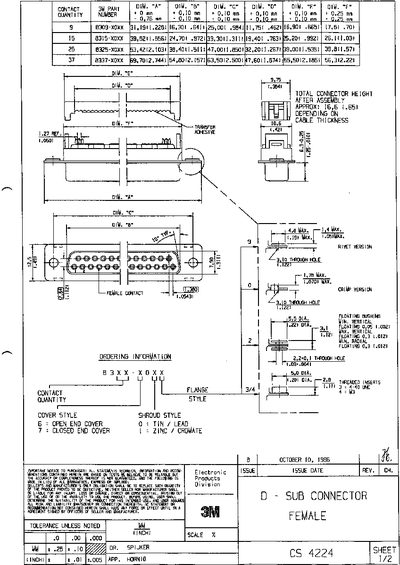
This document specifies the CS 4224 multipurpose socket connector, describing its dimensions, contact spacing and material construction. It is intended for use where a round conductor flat cable transitions to a plug connector with matching spacing.
Key performance data include a 1 A current rating, 1000 VRMS withstanding voltage, operating temperature from –55 °C to +105 °C, and a minimum 50 N push‑out force. Materials such as glass‑reinforced polyester insulators, steel shells with tin plating, and copper‑alloy contacts with selective gold over nickel are also listed.
| Contact spacing | .0545" x .112" (1.384 mm x 2.84 mm) |
|---|---|
| Insulator material | Glass reinforced polyester |
| Flammability rating | UL 94V-0 |
| Contact material | Copper alloy |
| Selective gold plating | Gold over nickel in functional area |
| Wire accommodation | 26 AWG solid or stranded; 28 AWG solid or stranded |
| Push‑out force | ≥ 50 N |
| Insulating resistance | > 1 × 10¹² Ω @ 500 VDC |
| Withstanding voltage | 1000 VRMS @ sea level |
| Temperature rating | ‑55 °C to +105 °C (67 °F to +221 °F) |
| Marking | Raised figures; 3M logo; part identification/date code |
It can operate from 67 °F to +221 °F (‑55 °C to +105 °C).
The insulator is made of glass reinforced polyester.
The connector requires a minimum push‑out force of 50 N.