
The MAX2121 is a low-cost, direct-conversion satellite receiver IC from MAXIM that is designed for satellite set-top and VSAT applications. The device directly converts the satellite signals from the LNB to baseband using a broadband I/Q downconverter. The operating frequency range extends from 925MHz to 2175MHz. The device includes an LNA and an RF variable-gain amplifier, I and Q downconverting mixers, and baseband lowpass filters and digitally controlled baseband variable-gain amplifiers. Together, the RF and baseband variable-gain amplifiers provide more than 80dB of gain control range. The device includes fully monolithic VCOs, as well as a complete fractional-N frequency synthesizer. Additionally, an on-chip crystal oscillator is provided along with a buffered output for driving additional tuners and demodulators. Synthesizer programming and device configuration are accomplished with a 2-wire serial interface. The IC features a VCO autoselect (VAS) function that automatically selects the proper VCO. For multituner applications, the device can be configured to have one of two 2-wire interface addresses. A low-power standby mode is available whereupon the signal path is shut down while leaving the reference oscillator, digital interface, and buffer circuits active, providing a method to reduce power in single and multituner applications. The device is the most advanced broadband/VSAT DBS tuner available. The low noise figure eliminates the need for an external LNA. A small number of digital circuits control the VCO and buffer amplifier.
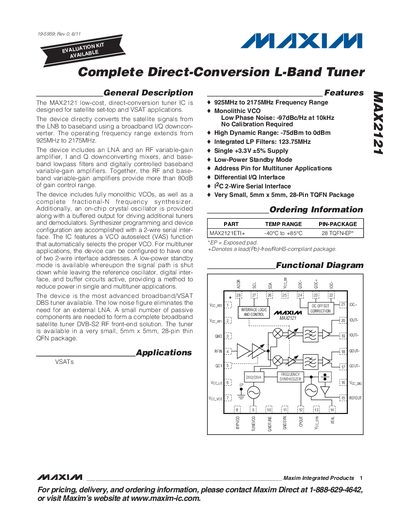
The MAX2121 integrates an LNA, RF variable‑gain amplifier, I/Q down‑converting mixers, baseband low‑pass filters, and digitally controlled baseband amplifiers, delivering over 80 dB of gain control. It includes a monolithic VCO, fractional‑N synthesizer, and a 2‑wire serial (I²C) interface for programming and configuration. The device is offered in a compact 5 mm × 5 mm 28‑pin TQFN package.
Typical applications are VSAT front‑ends and DBS receivers. The datasheet provides absolute maximum ratings, electrical characteristics, pin descriptions, and a typical application circuit to aid designers.
| Frequency Range | 925 MHz to 2175 MHz |
|---|---|
| Gain Control Range | more than 80 dB |
| Supply Voltage (VCC) | 3.13 V to 3.47 V |
| Operating Temperature Range | -40 °C to +85 °C |
| Package | 28‑pin TQFN‑EP, 5 mm × 5 mm |
| Low Phase Noise | -97 dBc/Hz at 10 kHz |
The MAX2121 operates from 925 MHz up to 2175 MHz.
The device is specified for a supply voltage between 3.13 V and 3.47 V.
The MAX2121 is supplied in a 28‑pin TQFN package.
Programming and configuration are performed via a 2‑wire serial (I²C) interface.