
The ATmega1280 is a high-performance, low-power microcontroller in the AVR® 8-bit microcontroller family that features 135 powerful instructions, most single-clock cycle execution, 32 x 8 general-purpose working registers, full static operation, up to 16 MIPS throughput at 16 MHz, an on-chip 2-cycle multiplier, 64K/128K/256K bytes of in-system self-programmable Flash, 4K bytes EEPROM, 8K bytes internal SRAM, 10,000 Flash/100,000 EEPROM write/erase cycles, 20 years of data retention at 85°C/100 years of data retention at 25°C, an optional boot code section with independent lock bits, in-system programming by on-chip boot program, true read-while-write operation, software security programming lock, up to 64K bytes optional external memory space, JTAG (IEEE std. 1149.1 compliant) interface, boundary-scan capabilities according to the JTAG standard, extensive on-chip debug support, programming of Flash, EEPROM, Fuses, and Lock Bits through the JTAG interface
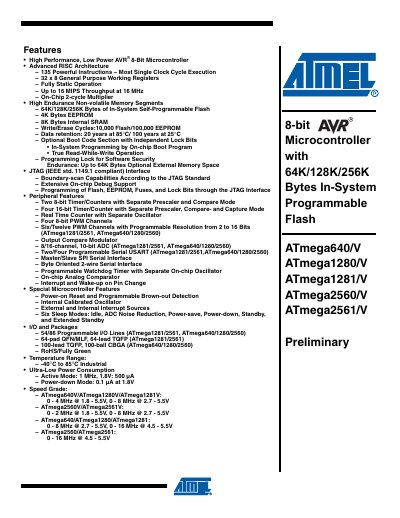
The ATmega640/1280/1281/2560/2561 family are low‑power CMOS 8‑bit microcontrollers based on the AVR enhanced RISC architecture. They deliver up to 1 MIPS per MHz and support a wide range of peripherals, making them suitable for many embedded control applications.
Key features include up to 256 KB of flash memory, multiple timer/counter units, up to 16‑channel 10‑bit ADC, several USARTs, SPI, I²C, JTAG debug interface, and extensive low‑power modes. The datasheet details pin‑outs for QFN, TQFP and CBGA packages, electrical characteristics, and ordering information.
| Flash memory | 64 KB / 128 KB / 256 KB |
|---|---|
| EEPROM | 4 KB |
| SRAM | 8 KB |
| Programmable I/O lines | 54 / 86 |
| ADC | 10‑bit, up to 16 channels |
| Timer/Counters | Four 16‑bit timers, two 8‑bit timers |
| USARTs | Two or four programmable serial USARTs |
| Operating temperature range | -40 °C to 85 °C (Industrial) |
| Active mode current (1 MHz, 1.8 V) | 500 pA |
| Power‑down mode current (1.8 V) | 0.1 pA |
The ATmega2560 provides 256 KB of In‑System Self‑Programmable Flash.
The ATmega1280 offers 86 programmable I/O lines.