
This is a PDF file. It is an advertisement for a chip database.
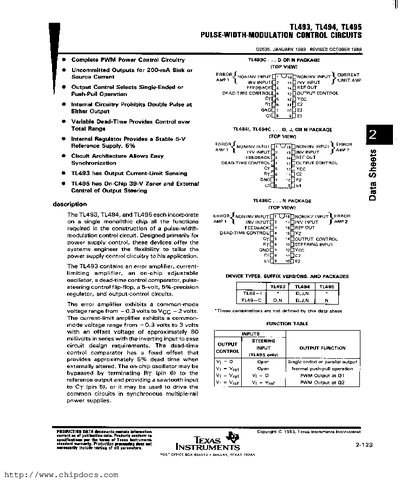
The TL493, TL494, and TL495 are monolithic PWM control ICs that integrate error amplifiers, current‑limiting amplifiers, on‑chip oscillators, dead‑time control comparators, and output‑control circuits. They support push‑pull or single‑ended operation and provide uncommitted outputs for flexible power‑supply designs.
The document provides absolute maximum ratings, recommended operating conditions, electrical characteristics, and typical performance graphs such as oscillator frequency versus timing resistance and amplifier voltage gain versus frequency. It also includes parameter test conditions for output voltage, current limits, timing components, and Zener diode specifications for the TL495 variant.
| Supply voltage (VCC) | 7 V to 40 V |
|---|---|
| Operating temperature range (TL494) | -25 °C to 85 °C |
| On‑chip Zener voltage (TL495) | 39 V |
The recommended supply voltage (VCC) is from 7 V to 40 V.
The TL494 is specified for operation from –25 °C to 85 °C.
Yes, the TL495 contains an on‑chip 39‑volt Zener diode for high‑voltage applications.