
ISL83386E is a 3.0V to 5.5V powered RS-232 transmitter/receiver that meets EIA/TIA-232 and V.28/V.24 specifications, even at VCC = 3.0V. Target applications are PDAs, palmtops, and cell phones where low operational, and even lower standby, power consumption is critical. Efficient on-chip charge pumps, coupled with a manual powerdown function reduces the standby supply current to a 1µA trickle. Small footprint packaging, and the use of small, low value capacitors ensure board space savings as well. Data rates greater than 250kbps are guaranteed at worst case load conditions. The ISL83386E features a VL pin that adjusts the logic pin (see Pin Descriptions table) output levels and input thresholds to values compatible with the VCC powering the external logic (e.g., a UART). The single pin powerdown function (SHDN = 0) disables all the receiver and transmitter outputs, while shutting down the charge pump to minimize supply current drain. Table 1 summarizes the features of the ISL83386E, while Application Note AN9863 summarizes the features of each device comprising the 3V RS-232 family.
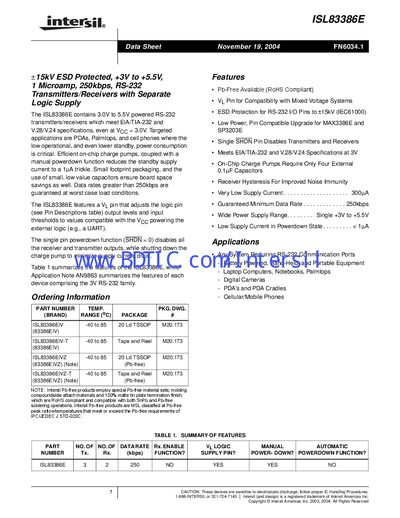
The ISL83386E is a single‑supply RS‑232 transmitter/receiver designed for low‑power portable applications such as PDAs, palmtops and cell phones. It operates from 3.0 V to 5.5 V, provides +15 kV ESD protection on the RS‑232 pins, and guarantees a minimum data rate of 250 kbps.
Key features include a V_ pin for logic‑level compatibility, a single SHDN pin for manual power‑down, on‑chip charge pumps that require only four 0.1 µF external capacitors, and low supply current (≈0.3 mA normal, <1 µA in power‑down). The device meets EIA/TIA‑232 and V.28/V.24 specifications.
| Operating Voltage Range | 3.0 V to 5.5 V |
|---|---|
| Minimum Data Rate | 250 kbps |
| Supply Current (power‑down) | < 1 µA |
| ESD Protection (RS‑232 pins) | +15 kV |
The device guarantees a minimum data rate of 250 kbps.
Only four 0.1 µF external capacitors are needed.
The SHDN pin disables all transmitter and receiver outputs and shuts down the on‑chip charge pump for low‑power standby.