
This product is a high-performance, low-power AVR® 8-bit microcontroller that uses an advanced RISC architecture with 133 powerful instructions, most of which execute in a single clock cycle. It has 32 8-bit general-purpose working registers and peripheral control registers, fully static operation, and up to 16 MIPS throughput at 16 MHz. It also has an on-chip 2-cycle multiplier.
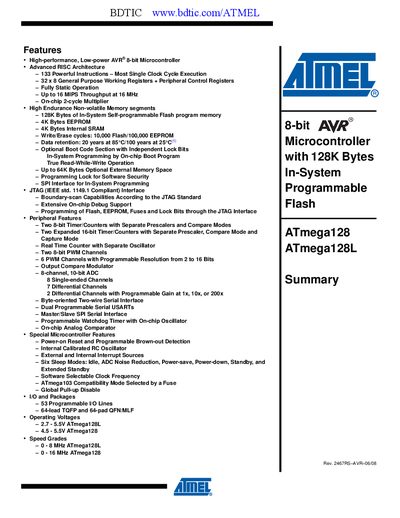
The ATmega128 and ATmega128L are low‑power CMOS 8‑bit microcontrollers based on Atmel's enhanced AVR RISC architecture. They offer up to 128 KB of flash, 4 KB EEPROM, 4 KB SRAM, 53 I/O lines, multiple timers, PWM channels, and an 8‑channel 10‑bit ADC, with speed grades up to 16 MHz.
The document includes a pinout diagram for TQFP and QFN/MLF packages, detailed port descriptions (Ports A‑G), power‑up/reset behavior, and programming interfaces such as SPI, JTAG, and two‑wire serial. Compatibility with the older ATmega103 and various operating voltage ranges are also described.
| Flash program memory | 128 KB |
|---|---|
| EEPROM | 4 KB |
| SRAM | 4 KB |
| I/O lines | 53 programmable I/O lines |
| ADC | 8‑channel, 10‑bit |
| Operating voltage (ATmega128L) | 2.7 V – 5.5 V |
| Operating voltage (ATmega128) | 4.5 V – 5.5 V |
| Package types | 64‑lead TQFP and 64‑pad QFN/MLF |
The device supports SPI, JTAG (IEEE std. 1149.1), and a byte‑oriented two‑wire serial interface for in‑system programming.
It provides 53 programmable I/O lines.
ATmega128L operates from 2.7 V to 5.5 V, while ATmega128 operates from 4.5 V to 5.5 V.
Both devices have 128 KB of in‑system self‑programmable flash memory.