
This document introduces the features and characteristics of Atmel's AVR ATmega328P microcontroller.
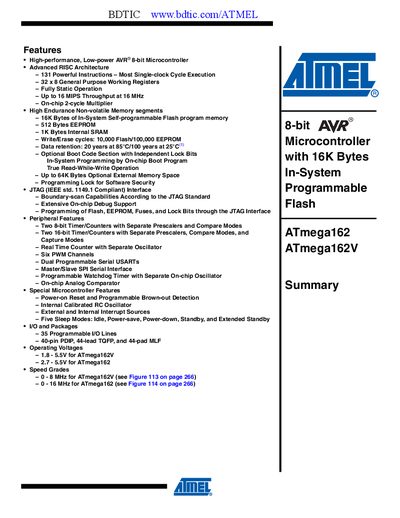
The ATmega162 is a low‑power 8‑bit AVR microcontroller with an advanced RISC architecture. It offers up to 16 MIPS throughput at 16 MHz, 16 KB of self‑programming Flash, 512 B EEPROM, and 1 KB SRAM. The device includes a rich peripheral set such as dual USARTs, SPI, six PWM channels, four flexible timer/counters, a programmable watchdog, and a JTAG interface for on‑chip debugging and boundary‑scan.
The microcontroller is available in 40‑pin PDIP, 44‑lead TQFP, and 44‑pad MLF packages, providing 35 programmable I/O lines. It operates from 2.7 V to 5.5 V (ATmega162) or 1.8 V to 5.5 V (ATmega162V) and supports multiple power‑saving modes. Detailed pin‑out diagrams, register summaries, and compatibility information with the ATmega161 are included in the document.
| Flash program memory | 16 KB |
|---|---|
| EEPROM | 512 B |
| SRAM | 1 KB |
| Operating voltage (ATmega162) | 2.7 V – 5.5 V |
| Operating voltage (ATmega162V) | 1.8 V – 5.5 V |
| Maximum throughput | Up to 16 MIPS at 16 MHz |
| Programmable I/O lines | 35 |
| Package options | 40‑pin PDIP, 44‑lead TQFP, 44‑pad MLF |
| Timers/Counters | Four flexible Timer/Counters |
| Serial interfaces | Dual USARTs, Master/Slave SPI |
| Watchdog Timer | Programmable with separate on‑chip oscillator |
| JTAG interface | IEEE 1149.1 compliant, boundary‑scan capable |
The ATmega162 provides 16 KB of In‑System Self‑programmable Flash memory.
The device offers 35 programmable I/O lines.
Yes, it includes a JTAG (IEEE 1149.1) compliant interface with boundary‑scan capabilities.