
This datasheet mainly introduces the characteristics and functions of the AVR® ATmega128A 8-bit microcontroller, including 131 powerful instructions, 32 x 8 general purpose registers, 20 MHz clock frequency at 20 MIPS throughput, 128K bytes of In-System Self-Programmable Flash, 4K bytes of EEPROM, 16K bytes of Internal SRAM and so on.
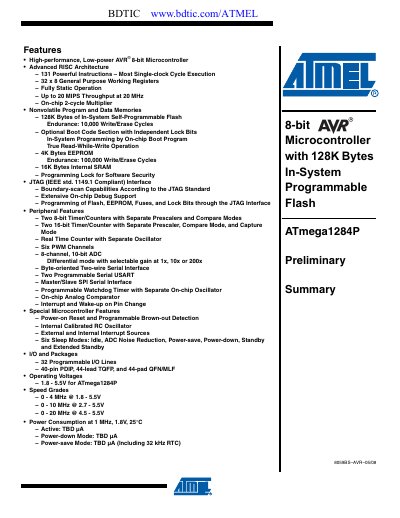
The ATmega1284P is a low‑power CMOS 8‑bit microcontroller based on the AVR enhanced RISC architecture. It delivers up to 20 MIPS at 20 MHz and includes a rich set of peripherals such as timers, ADC, USARTs, SPI, and JTAG for in‑system debugging.
Key features include 128 KB of In‑System Programmable Flash, 16 KB SRAM, 4 KB EEPROM, multiple power‑saving modes, and availability in 40‑pin PDIP, 44‑lead TQFP, and 44‑pad QFN/MLF packages. Development tools, application notes, and full datasheets are available from Atmel’s website.
| Flash Memory | 128 KB In‑System Programmable Flash |
|---|---|
| EEPROM | 4 KB |
| SRAM | 16 KB |
| Operating Voltage | 1.8 V – 5.5 V |
| Package Options | 40‑pin PDIP, 44‑lead TQFP, 44‑pad QFN/MLF |
| ADC | 8‑channel, 10‑bit |
| USARTs | Two programmable serial USARTs |
The device provides 128 KB of In‑System Programmable Flash memory.
It operates from 1.8 V up to 5.5 V.
The microcontroller is offered in 40‑pin PDIP, 44‑lead TQFP, and 44‑pad QFN/MLF packages.
It includes two programmable serial USART interfaces.