
The document describes a high-performance, low-power AVR® 8-bit microcontroller with advanced RISC architecture and various peripheral features.
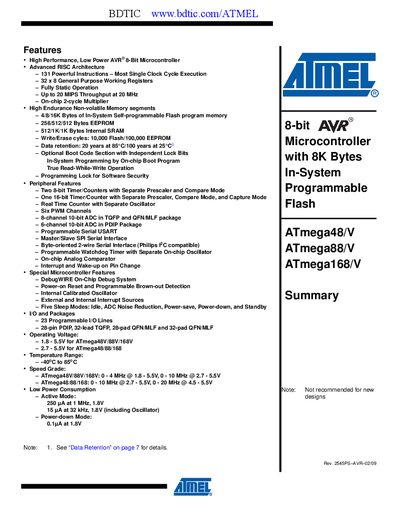
The ATmega48/88/168 family are low‑power 8‑bit AVR microcontrollers with up to 20 MIPS throughput, multiple timers, PWM channels, ADCs and a rich set of peripherals. They are offered in several memory sizes (4 KB‑16 KB Flash, 256‑512 B EEPROM, 512 B‑1 KB SRAM) and support a range of package types such as PDIP, TQFP and QFN/MLF.
The document provides a feature list, pin configurations, block diagram, register summary and programming notes, along with revision updates and errata. It is intended for designers needing a quick reference to the device’s capabilities and electrical characteristics.
| Operating Voltage | 1.8 – 5.5 V (ATmega48V/88V/168V) / 2.7 – 5.5 V (ATmega48/88/168) |
|---|---|
| Temperature Range | -40 °C to 85 °C |
| Flash Memory | 4 KB / 8 KB / 16 KB |
| EEPROM | 256 B / 512 B |
| SRAM | 512 B / 1 KB |
| Programmable I/O Lines | 23 |
| Package Types | 28‑pin PDIP, 32‑lead TQFP, 28‑pad QFN/MLF, 32‑pad QFN/MLF |
| Active Mode Power Consumption | 250 pA at 1 MHz, 1.8 V |
| Power‑down Mode Power Consumption | 0.1 pA at 1.8 V |
| Sleep Modes | Idle, ADC Noise Reduction, Power‑save, Power‑down, Standby |
| Data Retention | 20 years at 85 °C / 100 years at 25 °C |
The ATmega48/88/168 operate from 2.7 V to 5.5 V, while the V‑rated versions work from 1.8 V to 5.5 V.
Flash memory size varies by model: 4 KB for ATmega48, 8 KB for ATmega88, and 16 KB for ATmega168.
The devices support five sleep modes: Idle, ADC Noise Reduction, Power‑save, Power‑down, and Standby.
Data is retained for 20 years at 85 °C and for 100 years at 25 °C.