
This document describes the features and characteristics of the ATmega48/V, ATmega88/V, and ATmega168/V series of 8-bit microcontrollers, including high performance, low power consumption, advanced RISC architecture, non-volatile program and data memory, various peripheral features, and special microcontroller features.
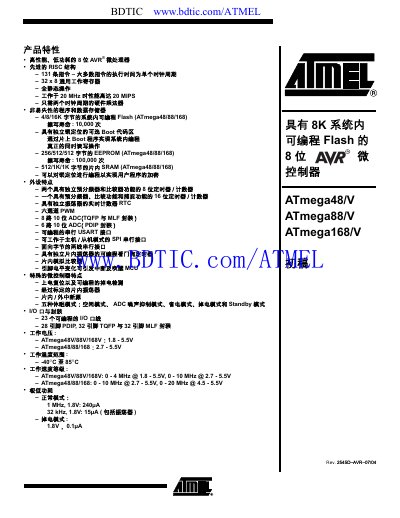
The ATmega48/88/168 family are low‑power 8‑bit AVR® microcontrollers with a rich set of peripherals, including multiple timers, USART, SPI, I²C, six‑channel PWM, up to 8‑bit ADCs and a programmable watchdog. They feature an advanced RISC core with 32 general‑purpose registers and can execute most instructions in a single clock cycle, delivering up to 20 MIPS at 20 MHz.
The devices are offered in PDIP, TQFP and MLF packages, provide up to 16 KB of flash, 1 KB of SRAM and 512 B of EEPROM, and support a variety of low‑power modes (idle, ADC‑noise‑reduction, power‑down, power‑save and standby) to minimise energy consumption in battery‑powered applications.
| Flash memory | 4 KB / 8 KB / 16 KB |
|---|---|
| EEPROM | 256 B / 512 B / 512 B |
| SRAM | 512 B / 1 KB / 1 KB |
| Operating voltage | 1.8 V – 5.5 V (ATmega48V/88V/168V) / 2.7 V – 5.5 V (ATmega48/88/168) |
| Operating temperature | -40 °C to 85 °C |
| Maximum clock speed | 20 MHz (20 MIPS) |
| Typical current consumption (normal mode) | 240 µA at 1 MHz, 1.8 V |
The ATmega48V/88V/168V versions operate from 1.8 V to 5.5 V, while the standard ATmega48/88/168 operate from 2.7 V to 5.5 V.
The devices provide 23 programmable I/O pins.
Five sleep modes are supported: idle, ADC‑noise‑reduction, power‑down, power‑save, and standby.
Typical current consumption is about 240 µA.