
This document introduces the features of ATmega48A/88A/168A/328P microcontrollers, including high performance, low power, up to 16MIPS throughput, 16K bytes of In-System self-programmable Flash, 1K bytes of internal SRAM and 1K bytes of EEPROM.
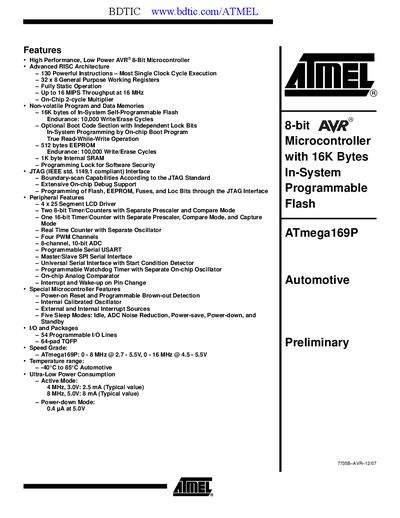
The ATmega169P is a low‑power CMOS 8‑bit microcontroller based on the AVR enhanced RISC architecture. It offers up to 16 MIPS throughput, 16 KB of In‑System Self‑Programmable Flash, 512 B EEPROM, 1 KB SRAM, 53 programmable I/O lines, 32 general‑purpose working registers, an 8‑channel 10‑bit ADC, multiple timers, four PWM channels, an LCD driver, JTAG debugging, and several power‑saving modes.
Designed for automotive applications, the device complies with ISO‑TS‑16949 and AEC‑Q100 grade 3, operating from –40 °C to 85 °C. It is available in a 64‑pad TQFP package and supports speed grades from 0‑8 MHz (2.7‑5.5 V) to 0‑16 MHz (4.5‑5.5 V). Typical active‑mode current is 2.5 mA at 4 MHz/3.0 V, while power‑down current is 0.4 µA at 5.0 V.
| Flash Memory | 16 KB |
|---|---|
| EEPROM | 512 B |
| SRAM | 1 KB |
| General‑purpose I/O lines | 53 |
| General‑purpose registers | 32 |
| ADC | 8‑channel, 10‑bit |
| PWM Channels | 4 |
| Active‑mode current (4 MHz, 3.0 V) | 2.5 mA (typical) |
| Operating Temperature (Automotive) | -40 °C to 85 °C |
| Package | 64‑pad TQFP |
| Speed Grade | 0‑8 MHz @ 2.7‑5.5 V, 0‑16 MHz @ 4.5‑5.5 V |
The ATmega169P provides 16 KB of In‑System Self‑Programmable Flash memory.
It offers 53 general‑purpose I/O lines.
The device operates from –40 °C to 85 °C for automotive applications.
Typical active‑mode current is 2.5 mA.