
This document describes the features and characteristics of a 16-bit, 100 kSPS, single-ended PulSAR ADC, including resolution, throughput, analog input range, supply voltage range, and serial interface.
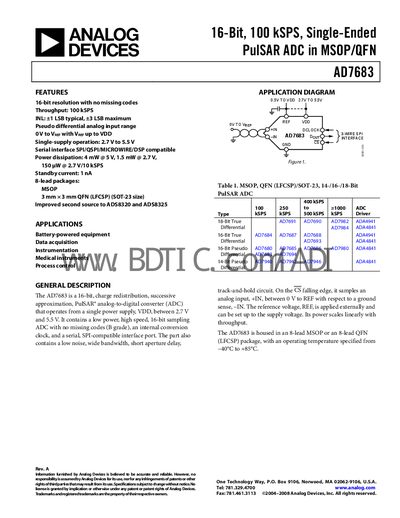
The AD7683 is a 16‑bit, charge‑redistribution successive‑approximation PulSAR ADC that operates from a single supply (2.7 V to 5.5 V). It offers 100 kSPS throughput, no missing codes, and a serial SPI/QSPI/MICROWIRE interface. Typical power dissipation is 4 mW at 5 V and 1.5 mW at 2.7 V, with a standby current of only 1 nA.
The device is available in 8‑lead MSOP and 8‑lead QFN (LFCSP) packages and is suited for battery‑powered equipment, data‑acquisition systems, instrumentation, and medical applications. Ordering information, pin descriptions, timing specifications, and absolute maximum ratings are provided for design engineers.
| Resolution | 16 bits |
|---|---|
| Throughput | 100 kSPS |
| Supply Voltage | 2.7 V to 5.5 V |
| Power Dissipation | 4 mW @5 V, 1.5 mW @2.7 V |
| Standby Current | 1 nA |
| Package Options | 8‑lead MSOP or 8‑lead QFN (LFCSP) |
The AD7683 can sample at up to 100 kSPS.
It operates from 2.7 V to 5.5 V.
The standby current is 1 nA.
The device is offered in 8‑lead MSOP and 8‑lead QFN (LFCSP) packages.