
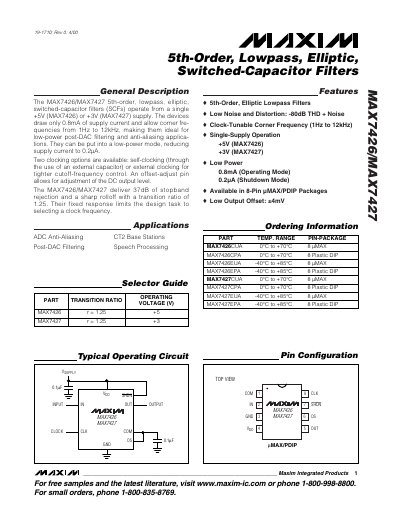
The MAX7426 (5 V) and MAX7427 (3 V) are 5th‑order elliptic low‑pass switched‑capacitor filters that operate from a single supply and draw only 0.8 mA in normal mode. They provide a transition ratio of 1.25, 37 dB stop‑band rejection, and a corner‑frequency range from 1 Hz to 12 kHz, making them suitable for low‑power anti‑aliasing and post‑DAC filtering.
The devices include an offset‑adjust pin, two clocking options (self‑clocking via an external capacitor or external clock), and a shutdown mode that reduces supply current to 0.2 µA. Typical applications are ADC anti‑aliasing, base‑station front‑ends, and speech‑processing circuits. Pin configurations, absolute‑maximum ratings, and detailed electrical characteristics are provided for both µMAX and PDIP packages.
| Supply Voltage (VDD) | +5 V (MAX7426) / +3 V (MAX7427) |
|---|---|
| Operating Supply Current | 0.8 mA |
| Shutdown Supply Current | 0.2 µA |
| Stopband Rejection | 37 dB |
| Transition Ratio (r) | 1.25 |
| Corner‑Frequency Range | 1 Hz – 12 kHz |
| Output Offset Voltage | ±4 mV |
| Package Types | 8‑pin µMAX, 8‑pin PDIP |
In shutdown mode the supply current drops to 0.2 µA.
Both devices provide about 37 dB of stopband rejection.
Yes, dual‑supply operation is supported; see the dual‑supply diagram in the document.