
This document describes the research and development work on a linear collider detector in the United States and Asia, focusing on the design and development of a detector based on silicon tracking and a pixel (CCD) vertex detector.
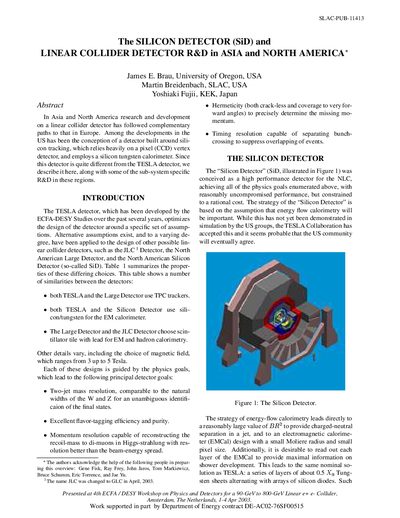
The Silicon Detector (SiD) is a proposed high‑performance detector for a linear collider, featuring silicon tracking, a silicon‑tungsten electromagnetic calorimeter, and a compact design aimed at cost efficiency. The document describes the detector’s layout, key parameters such as a 5 T magnetic field and a 1.25 m tracker radius, and compares it with other concepts like TESLA and the Large Detector.
It also summarizes ongoing research and development in North America, covering tracking technologies, vertex detectors, calorimetry, muon systems, and beam‑line instrumentation, with cost estimates and future work plans.
| Magnetic field | 5 T |
|---|---|
| Tracker outer radius | 1.25 m |
| EMCal layers | 30 |
| W thickness in EMCal | 2.5 mm |
| Total EMCal radiation length | 21.4 X₀ |
The SiD design uses a 5 tesla magnetic field.
The EMCal consists of 30 layers.
The tracker outer radius is set to 1.25 meters.
Each tungsten plate is 2.5 mm thick.