
This document is the user manual for Delta products, which introduces the installation, usage precautions, and technical specifications of the products. The product adopts PID control method and supports various input sensor types and output accessory types. It has features of dustproof, moisture-proof, and electric shock prevention.
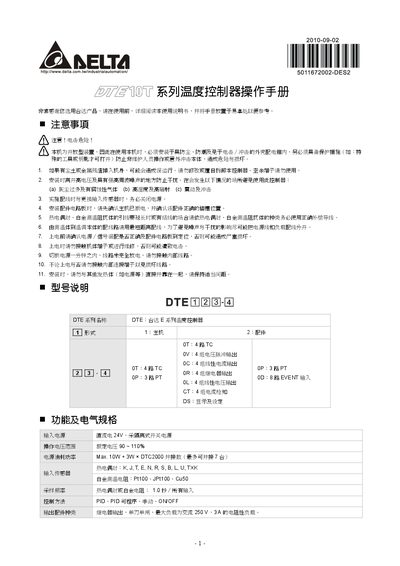
This manual covers the safe installation and wiring of the Delta DTE10T temperature controller, including required protective enclosures, power connections, and sensor wiring. It also explains the function of each terminal and the recommended mounting practices.
The document details configuration of input sensors, output types, communication settings (RS‑485, Modbus), PID/ON‑OFF control modes, alarm functions, CT and EVENT features, filter settings, and troubleshooting. Parameter tables and register addresses are provided for advanced programming via PC software. This manual is written in Chinese.
| Power consumption | Max 10W + 3W per DTC2000 |
|---|---|
| Supported thermocouple types | K, J, T, E, N, R, S, B, L, U, TXK |
| Analog voltage output | 0 ~ 10 V (load > 1 kΩ) |
| RS‑485 communication speed | 2,400 ~ 115,200 bps |
| Communication protocol | Modbus RTU/ASCII |
| Vibration resistance | 10 ~ 55 Hz, 10 m/s² (3 axes, 10 min) |
| Shock resistance | Max 300 m/s² (3 axes, 6 directions, 3×) |
Set the RS‑485 interface to use the Modbus protocol and choose a baud rate between 2,400 and 115,200 bps; the device address and data format (RTU or ASCII) are also configurable.
The controller accepts thermocouple pairs (K, J, T, E, N, R, S, B, L, U, TXK) and resistance sensors such as Pt100, JPt100, and Cu50.