
Key facts
Start here
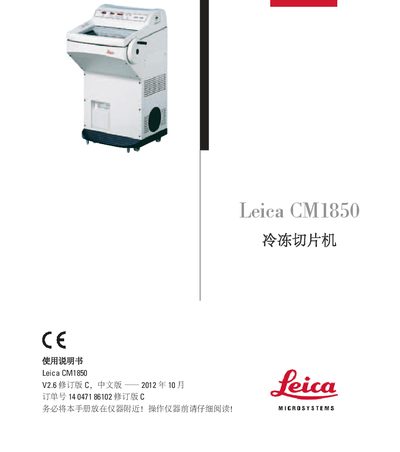
Leica CM1850 User Manual V2.6
This manual describes the Leica CM1850 cryostat, covering important safety information, instrument overview, control panel operation, and daily use procedures. It explains how to set target values, adjust temperature, and operate the Peltier element for rapid sample freezing.
The guide also includes cleaning, disinfection, routine maintenance, troubleshooting steps, and ordering information for optional accessories. Safety features such as the handwheel lock and blade guard are detailed, and the document emphasizes the need for trained personnel before operation.
Leica CM1850 specifications
| Section thickness setting | 1 - 60 µm |
|---|---|
| Specimen feed | 25 mm |
| Vertical stroke | 59 mm |
| Maximum specimen size | 55 x 55 mm |
| Cryocabinet width (without handwheel) | 600 mm |
| Weight (incl. microtome) | approx. 135 kg |
| Compressor start‑up current | 45 – 50 A |
| Fuses (type F1) | T0.25 A |
All Leica CM1850 documents by type
Day-to-day operation, settings and troubleshooting. Start here if the product is already set up.
Questions answered in these manuals
What safety features does the Leica CM1850 have?
The instrument includes a safety handwheel lock and a blade guard on the knife holder to protect the operator.
How do I lock the handwheel before changing samples?
Rotate the handle to the top position, insert the lock pin (T) into the handwheel slot, and push it left to unlock when needed.
What safety steps must be taken before manipulating the knife?
The handwheel must be locked and the cutting edge covered with the knife guard before any knife or specimen handling.
How long should you wait after transporting the instrument before turning it on?
Wait at least 4 hours after transport before powering the instrument on.