
This application note describes a column‑switching ion chromatography method for determining trace anion impurities in high‑purity fluoride reagents using…
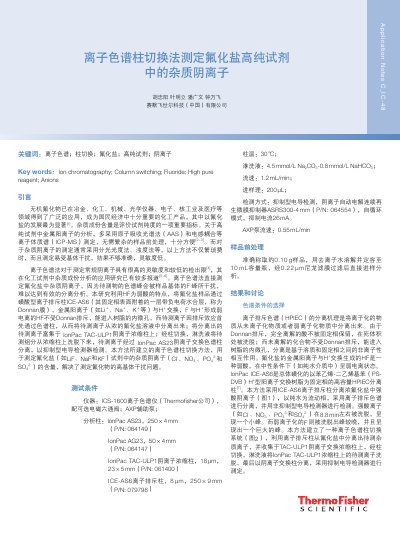
The note introduces a column‑switching approach that combines an ion‑exclusion column (ICE‑AS6) and an anion‑exchange column (AS23) to separate trace anions (Cl⁻, NO₃⁻, PO₄³⁻, SO₄²⁻) from high‑concentration fluoride matrices. By exploiting the weak acidity of HF, the method eliminates matrix interference and enables accurate quantification.
Experimental conditions include a column temperature of 30 °C, eluent 4.5 mmol/L Na₂CO₃‑0.8 mmol/L NaHCO₃ at 1.2 mL/min, injection volume 200 µL, and suppressed conductivity detection. The optimal column‑switching time was found to be 5.5–10.5 min, providing good linearity (R² > 0.999) and low detection limits (0.2–3.0 mg/kg). Sample analyses of LiF, NaF and KF showed recoveries of 92–104 % with RSD < 3 %. This manual is written in Chinese.
| Eluent composition | 4.5 mmol/L Na₂CO₃‑0.8 mmol/L NaHCO₃ |
|---|---|
| Flow rate (chromatography) | 1.2 mL/min |
| Injection volume | 200 µL |
| Suppressor current | 26 mA |
| Auxiliary pump flow rate | 0.55 mL/min |
The best switching time was determined to be between 5.5 and 10.5 minutes.
The limits of detection are 0.2 mg/kg for Cl⁻, 0.6 mg/kg for NO₃⁻, 3.0 mg/kg for PO₄³⁻ and 0.5 mg/kg for SO₄²⁻.
Recoveries ranged from 92.0 % to 103.5 % with relative standard deviations below 3 %.