
The Philips SLEV400 RFID module specification sheet details its 13.56 MHz operation, EEPROM layout, anti‑collision, EAS and QUIET features, and electrical…
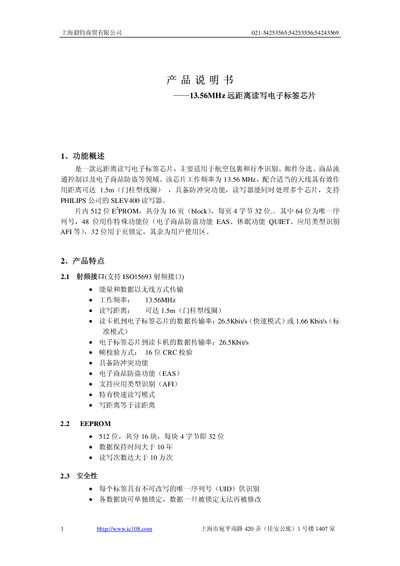
The SLEV400 is a 13.56 MHz RFID chip designed for long‑range tag reading in applications such as baggage handling, mail sorting, and anti‑theft. It includes a 512‑bit EEPROM divided into 16 blocks, each 4 bytes, with a 64‑bit unique identifier (UID) and special function bits for EAS, QUIET, and application type identification.
The document provides the memory structure, command set (including anti‑collision, selected/unselected reads, write, halt, and reset QUIET), and electrical specifications such as storage temperature range, operating voltage, input current, and EEPROM endurance. This manual is written in Chinese.
| Storage temperature range | -55 °C to +140 °C |
|---|---|
| Operating environment temperature | -25 °C to +70 °C |
| Operating junction temperature | -25 °C to +85 °C |
| Input current | 40 mA rms |
| Minimum input voltage (READ, standard mode) | 2.4 V |
| Minimum input voltage (WRITE, standard mode) | 2.6 V |
| Minimum input voltage (READ/WRITE, fast mode) | 2.9 V |
| Operating frequency | 13.553 MHz – 13.567 MHz |
| EEPROM write endurance | 100 000 cycles |
| Input capacitance (VLA‑LB=2 Vrms) | 25.5 pF |
It operates at 13.56 MHz, with a specified range of 13.553 MHz to 13.567 MHz.
The UID is 64 bits long.
The EEPROM contains 16 blocks, each 4 bytes (32 bits).
Up to about 1.5 m.