
A laboratory guide describing the purpose, theory, setup, and procedures for measuring rotational inertia and circular motion.
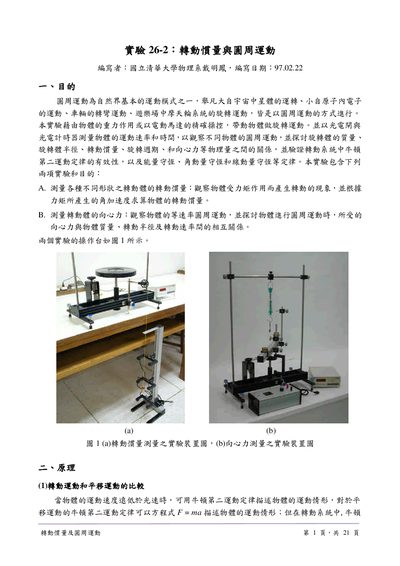
The guide explains the purpose of the experiment, which is to study rotational inertia and circular motion using gravity or a precisely controlled motor to drive the rotating body. It also outlines the theoretical background, including torque, moment of inertia, and centripetal force relationships.
The document lists the required apparatus—light‑gate timers, a rotating platform, pulleys, masses, a DC motor, and measurement tools—and provides step‑by‑step procedures for measuring rotational inertia and centripetal force, as well as data analysis methods. This manual is written in Chinese.
The experiment aims to study rotational inertia and circular motion, verify Newton’s second law, and explore relationships among mass, radius, period, and centripetal force.
Rotational inertia is determined by measuring the acceleration of a falling mass with three light‑gate timers, calculating the torque, and using the relation τ = I·α.