
This datasheet describes the Intersil ISL29003, an integrated light sensor with a 16-bit ADC, I2C interface, and programmable lux range select for ambient…
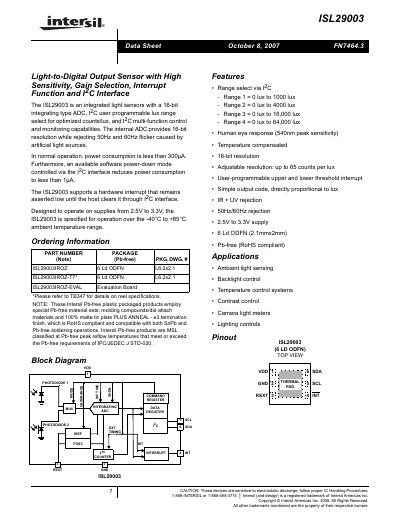
The ISL29003 is an integrated light-to-digital output sensor featuring a 16-bit integrating type Analog-to-Digital Converter (ADC) and an I2C user-programmable interface. It includes capabilities for optimized counts per lux, multi-function control, monitoring, and hardware interrupts with programmable thresholds.
The device supports four selectable ranges via the I2C interface to accommodate various lighting conditions, from 0 to 16,000 lux up to 0 to 64,000 lux. It features human eye response (540nm peak sensitivity), temperature compensation, and rejection of IR/UV light as well as 50Hz and 60Hz flicker noise.
| Supply Voltage Range | 2.5V to 3.3V (Operating) |
|---|---|
| Resolution | 16-bit |
| Operating Temperature Range | -40°C to +85°C |
| Package Type | 6 Ld ODFN (2.1mm x 2mm) |
| Supply Current (Normal Operation) | < 300µA |
The device supports four ranges: Range 1 (0 to 1000 lux), Range 2 (0 to 4000 lux), Range 3 (0 to 16,000 lux), and Range 4 (0 to 64,000 lux).
Yes, it rejects 50Hz and 60Hz flicker caused by artificial light sources.
It features a human eye response with a peak sensitivity at 540nm.