
The X98027 is a 275MHz triple video digitizer with a digital PLL. It contains all the components necessary to digitize analog RGB or YUV graphics signals from personal computers, workstations, and video set-top boxes. The fully differential analog design provides high PSRR and dynamic performance to meet the stringent requirements of the graphics display industry. The AFE's 275MSPS conversion rate supports resolutions up to QXGA at a 60Hz refresh rate, while the high input bandwidth ensures sharp images at the highest resolutions. To minimize noise, the X98027's analog section features 2 sets of pseudo-differential RGB inputs with programmable input bandwidth, as well as internal DC restore clamping (including mid-scale clamping for YUV signals). This is followed by the programmable gain/offset stage and the three 275MSPS analog-to-digital converters (ADCs). Automatic Black Level Compensation (ABLC™) eliminates part-to-part offset variation, ensuring perfect black level performance in every application. The X98027's digital PLL generates a pixel clock from the analog source.
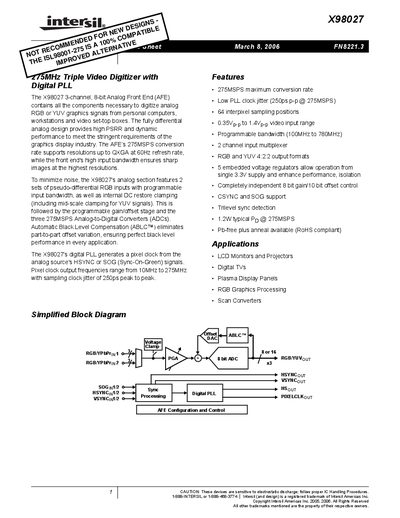
The X98027 Triple Video Digitizer integrates a complete analog front end for digitizing RGB or YUV graphics signals from PCs, workstations, and set‑top boxes. It offers a 275 MSPS conversion rate, up to QXGA resolution at 60 Hz, and programmable input bandwidth from 100 MHz to 780 MHz.
The device includes a digital PLL for pixel‑clock generation (10 MHz‑275 MHz), low‑jitter operation, and a 128‑lead MQFP package with full pin‑out details. Electrical specifications, absolute maximum ratings, and serial‑bus interface timing are provided for design reference.
| Maximum conversion rate | 275 MSPS |
|---|---|
| Input voltage range | 0.35 V‑p‑p to 1.4 V‑p‑p |
| Programmable bandwidth | 100 MHz – 780 MHz |
| Typical power dissipation | 1.2 W at 275 MSPS |
| Pixel‑clock output range | 10 MHz – 275 MHz |
The device can convert up to 275 MSPS per channel.
The digital PLL provides a pixel clock from 10 MHz to 275 MHz.
The input bandwidth can be programmed between 100 MHz and 780 MHz.