
The EL2480 is a quad current-feedback operational amplifier that achieves a -3dB bandwidth of 250MHz at a gain of +1 while consuming only 3mA of supply current per amplifier. It will operate with dual supplies ranging from ±1.5V to ±6V, or from single supplies ranging from +3V to +12V. In spite of its low supply current, the EL2480 can output 55mA while swinging to ±4V on ±5V supplies. These attributes make the EL2480 an excellent choice for low power and/or low voltage cable-driver, HDSL, or RGB applications. For triple applications with disable, consider the EL2386 (16-pin triple).
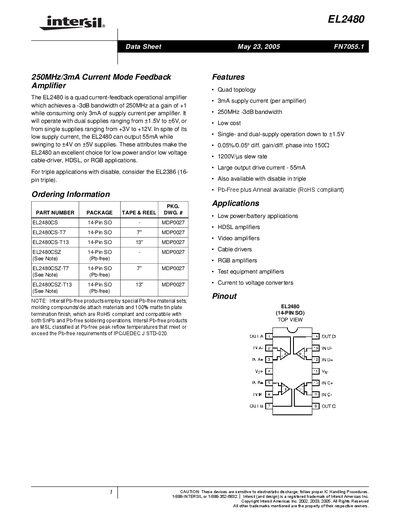
The EL2480 is a quad current‑feedback operational amplifier that delivers a -3 dB bandwidth of 250 MHz at a gain of +1 while consuming only 3 mA per amplifier. It operates from dual supplies of +1.5 V to +6 V or single supplies of +3 V to +12 V, and can source up to 55 mA output current.
Typical applications include low‑power cable drivers, HDSL, and RGB video amplifiers. Ordering information, package options, and detailed electrical specifications are provided for designers.
| -3 dB Bandwidth | 250 MHz |
|---|---|
| Supply Current per Amplifier | 3 mA |
| Maximum Output Current | 55 mA |
| Slew Rate | 1200 V/µs |
| Operating Ambient Temperature Range | -40 °C to +85 °C |
Each amplifier can output up to 55 mA.
The device has a slew rate of 1200 V/µs.