
User manual for the HMS Industrial Networks Anybus Wireless Bolt, covering installation, configuration, and technical data.
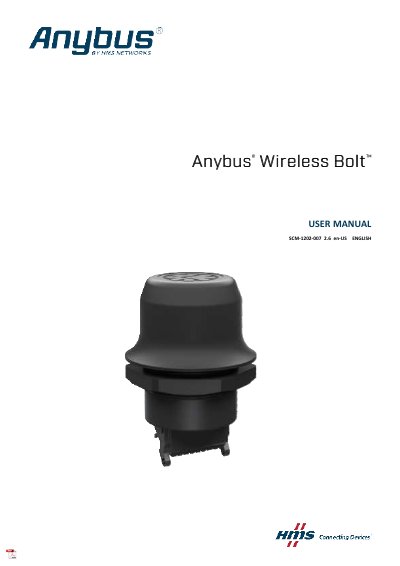
Anybus Wireless Bolt provides wireless communication over WLAN and/or Bluetooth to wired networks. Typical applications include adding wireless cloud connectivity to industrial devices, accessing devices from a laptop, smartphone, or tablet, and Ethernet cable replacement between devices.
The manual covers safety and installation requirements, mechanical mounting, connectors, Ethernet cabling, digital input, RESET button use, web-based configuration, factory restore, configuration examples, wireless technology basics, and hardware and communication technical data.
| Maximum range | 100 m (WLAN and Bluetooth) |
|---|---|
| Operating temperature | Shadow: -40 to +65 °C; direct sunlight: -40 to +45 °C or -40 to +65 °C |
| Storage temperature | -40 to +85 °C |
| Power supply | 9–30 VDC (-5 % +20 %) |
| Power consumption | 0.7 W idle, 1.7 W max. |
| Protection class | Top (outside of host): IP67 / UL NEMA 4X; base (inside of host): IP21 |
| Dimensions | Height: 75 mm (95 mm incl. connector, 41 mm outside); diameter: 68 mm |
| Weight | 81 g |
| Mounting | M50 screw and nut (50.5 mm hole needed) |
| Ethernet interface | 10/100BASE-T with automatic MDI/MDIX auto cross-over detection |
| WLAN standards | IEEE 802.11 a, b, g, n, d, r |
| WLAN RF output power | 18 dBm EIRP (including max antenna gain 3 dBi) |
| WLAN net data throughput | 20 Mbps |
| Classic Bluetooth net data throughput | ~1 Mbps |
| Bluetooth Low Energy net data throughput | ~200 kbps |
It provides wireless communication over WLAN and/or Bluetooth to wired networks for applications such as wireless cloud connectivity, device access from laptops or mobile devices, and Ethernet cable replacement.
Bluetooth is recommended when an interruption-free connection or interference robustness matters more than throughput, or when a Profinet I/O cycle time or EtherNet/IP RPI of 64 ms or more is acceptable.
A minimum distance of 50 cm between devices should be observed to avoid interference.
The mounting nut should be tightened to 5 Nm ±10 %.