
This manual describes the technical features of the EtherNet/IP to Serial linking device, including the PC-based configuration software.
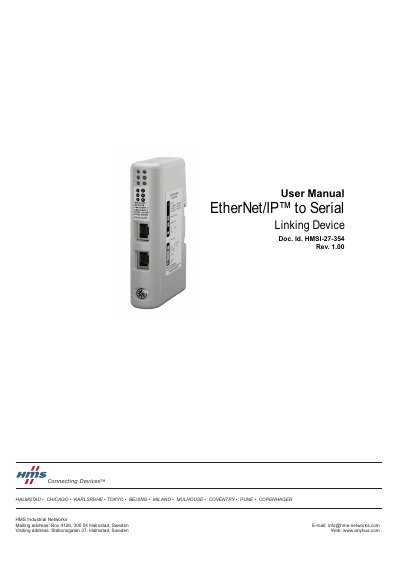
This user manual provides detailed instructions for configuring and operating the EtherNet/IP to Serial Linking Device by HMS Industrial Networks. It includes sections on hardware installation, protocol modes, node management, transaction handling, and configuration tools like Studio 5000 and the Configuration Manager. The device acts as a gateway between serial protocols and EtherNet/IP networks, supporting up to 31 nodes with RS-232, RS-422, or RS-485 standards. It requires familiarity with PLCs, communication systems, and Microsoft Windows.
The manual also covers advanced topics such as CIP object implementation, subnetwork monitoring, data logging, and troubleshooting. Technical specifications include electrical, environmental, and regulatory compliance details. It is intended for users with technical backgrounds in industrial automation and networking.
| Max Ambient Temperature | 55 °C (for Hazloc environments) |
|---|---|
| Wire Type | Cu only, 14–30 AWG |
| Terminal Tightening Torque | 5–7 lb-in (0.5–0.8 Nm) |
| Pollution Degree | 1 |
| Working Voltage | 250 V RMS or 250 VDC |
| Secondary Circuit Transient Rating | 500 V |
It supports RS-232, RS-422, and RS-485 physical standards for serial communication.
The linking device can address up to 31 nodes.
The user must be familiar with the Microsoft® Windows® operating system.
It acts as a gateway between serial application protocols and EtherNet/IP-based networks.