
User manual for Hantek DSO1000 series handheld oscilloscope covering safety, operation, specifications and troubleshooting.
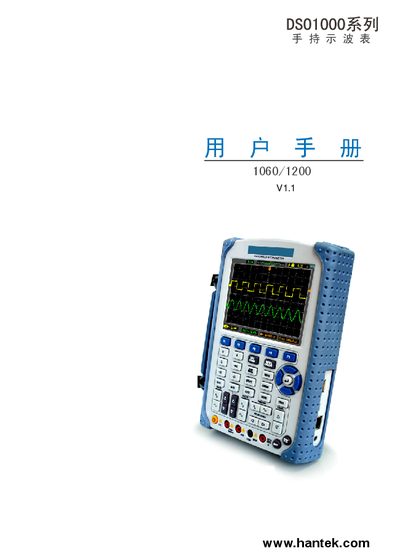
The Hantek DSO1000 series handheld oscilloscope manual provides a complete guide to safely set up, operate, and maintain the device. It includes safety symbols, general checks, front‑panel description, connection instructions, and detailed functional settings for vertical, horizontal, and trigger systems.
Later sections cover application examples, a built‑in digital multimeter, troubleshooting procedures, technical specifications, and appendices with accessories, warranty information, and cleaning/maintenance tips. This manual is written in Chinese.
| Bandwidth | 60 MHz (DSO1060) / 200 MHz (DSO1200) |
|---|---|
| Maximum Real‑time Sample Rate | 150 MSa/s (DSO1060) / 500 MSa/s (DSO1200) |
| Memory Depth | 32 K points (single‑channel) / 16 K points per channel (dual‑channel) |
| Display | 5.7‑inch TFT LCD, 320 × 240 pixels, LED backlight |
| USB Interface | USB 2.0 |
| Power Supply | AC 100‑240 V, 50‑60 Hz; DC 8.5 V @ 1.5 A |
| Battery Runtime | Up to 6 hours |
| Dimensions | 245 × 163 × 52 mm |
| Weight | 1.2 kg |
The DSO1060 model has a bandwidth of 60 MHz.
The internal battery can power the device for up to six hours.
The device supports USB 2.0.