
The ATmega16(L) is an 8-bit AVR microcontroller featuring up to 16 KB flash, 512 B EEPROM, and a range of peripherals.
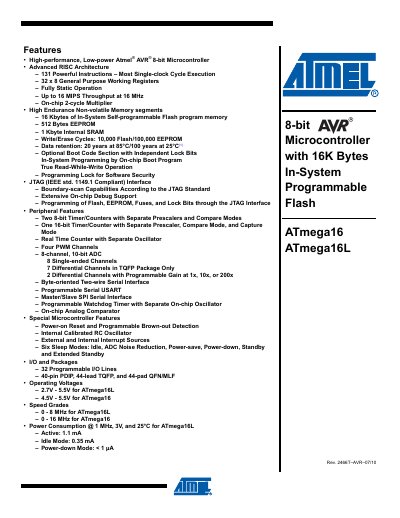
The ATmega16(L) is a low‑power CMOS 8‑bit microcontroller based on Atmel's AVR enhanced RISC architecture. It provides up to 16 MIPS throughput at 16 MHz, a rich set of peripherals, and extensive on‑chip debugging and programming support via JTAG.
Key features include 16 KB of self‑programmable flash, 512 B EEPROM, 1 KB SRAM, multiple timers, PWM channels, an 8‑channel 10‑bit ADC, and up to 32 programmable I/O lines. The device is offered in 40‑pin PDIP, 44‑lead TQFP, and 44‑pad QFN/MLF packages and operates from 2.7 V to 5.5 V depending on the variant.
| Flash Memory | 16 KB |
|---|---|
| EEPROM | 512 B |
| SRAM | 1 KB |
| General Purpose Registers | 32 × 8 bits |
| Operating Voltage (ATmega16L) | 2.7 V – 5.5 V |
| Maximum Clock Speed (ATmega16L) | 8 MHz |
| Power Consumption (ATmega16L, 1 MHz, 3 V) | Active: 1.1 mA |
| PWM Channels | 4 |
| ADC | 8‑channel, 10‑bit |
| 8‑bit Timer/Counters | 2 |
| 16‑bit Timer/Counter | 1 |
| Programmable I/O Lines | 32 |
It provides 16 KB of In‑System Self‑Programmable Flash memory.
The ATmega16L operates from 2.7 V to 5.5 V.
It includes an 8‑channel, 10‑bit ADC.
This manual explains 2 error codes. Open a code for its meaning, causes and what to do: