
User manual for Arduino Nano 33 IoT, a miniature module with Cortex M0+ processor, WiFi/BT, crypto chip, and 6-axis IMU.
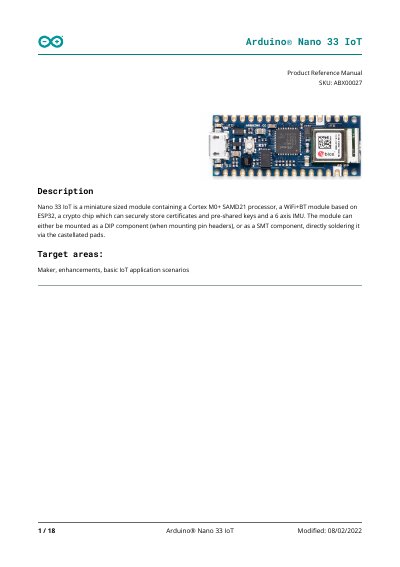
The Arduino Nano 33 IoT is a compact module designed for makers and IoT applications. It integrates a Cortex M0+ SAMD21 processor, a WiFi/BT module based on ESP32, a crypto chip for secure storage, and a 6-axis IMU. The board can be mounted as a DIP or SMT component. It supports programming via Arduino IDE, Web Editor, or IoT Cloud, and includes sample sketches and online resources for development.
Key features include a 256KB flash, 32KB RAM, USB connectivity, and support for real-time sensor data logging. The board operates within a temperature range of -40°C to 85°C and is powered via USB or headers, with 3.3V I/Os only. It includes a secure crypto chip for storing certificates and keys, and an IMU for motion sensing and orientation tracking.
| Flash Memory | 256KB |
|---|---|
| WiFi/BT Module | NINA W102 based on ESP32 |
| Crypto Chip | ATECC608A |
| IMU | LSM6DSL 6-axis |
| Operating Temperature | -40°C to 85°C |
| Input Voltage | Up to 21V |
| I/O Voltage | 3.3V only |
It uses a Cortex M0+ SAMD21 processor running at up to 48MHz.
It is based on ESP32 and connects via serial and SPI pins to the SAMD21 processor.
It securely stores certificates and keys and accelerates secure protocols without exposing secrets in plain text.
The board can be powered via USB or headers with a maximum input voltage of 21V.