
The ADP3335 is a 500 mA low‑dropout regulator with ±0.9% accuracy, ultralow quiescent current and anyCAP® capacitor compatibility.
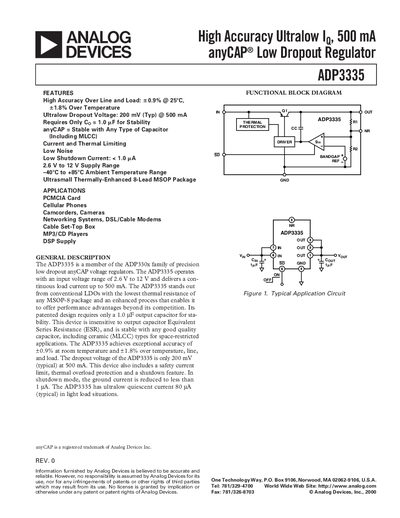
The ADP3335 low‑dropout regulator from Analog Devices operates from 2.6 V to 12 V input and delivers up to 500 mA continuous load current. It features high accuracy over line and load (±0.9% at 25 °C), an ultralow dropout voltage of 200 mV typ, and a shutdown ground current of less than 1 µA.
The device is stable with any type of capacitor (including MLCC) using only a 1 µF output capacitor. It includes current‑limit, thermal overload protection, a noise‑reduction pin, and a paddle‑under‑lead package that provides a thermal resistance of 110 °C/W in an MSOP‑8 footprint.
| Dropout Voltage (500 mA) | 200 mV typ |
|---|---|
| Maximum Output Current | 500 mA |
| Input Voltage Range | 2.6 V to 12 V |
| Shutdown Ground Current | < 1 µA |
The typical dropout voltage is 200 mV at a load of 500 mA.
In shutdown mode the ground current drops to less than 1 µA.
Only a 1 µF output capacitor is needed for stability; larger capacitors are also allowed.