
TQXJ-S series high-precision one-dimensional inclination angle sensors adopt micro-mechanical structure technology, integrated magnetic resistance chips and single-chip microcomputer signal processing technology, which can accurately measure and track the size and change of inclination angle. The use of micro-mechanical technology has solved the problem of poor anti-vibration of general tilt angle sensors. The integrated magnetic resistance chip uses a non-contact method to sense the change of angle, greatly improving the reliability and frequency response performance of the product; the use of single-chip microcomputer technology improves the accuracy of temperature compensation of the product, making the product in the high temperature use The drift is very small. This product is a replacement for the traditional gravity pendulum structure inclination angle sensor.
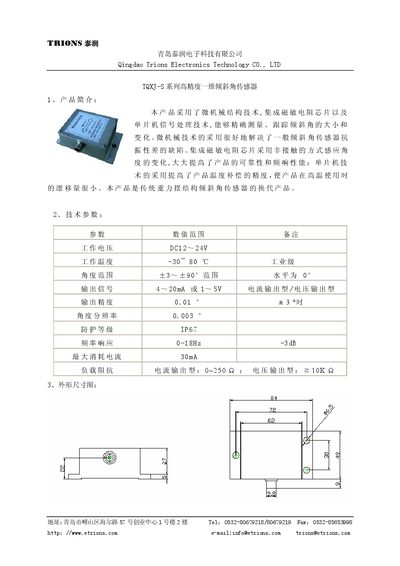
The TQXJ‑S series is a high‑accuracy one‑dimensional tilt angle sensor that uses MEMS structure, integrated magnetoresistive chips, and a microcontroller for precise angle measurement and temperature compensation. It offers both current (4‑20 mA) and voltage (1‑5 V) output options with IP67 protection and a frequency response up to 18 Hz.
The manual includes technical parameters, wiring diagrams, step‑by‑step installation guidance, and recommended application fields such as construction, oil, and lifting machinery. Contact information for Qingdao Trions Electronics Technology Co., Ltd. is also provided. This manual is written in Chinese.
| Operating Voltage | DC12‑24 V |
|---|---|
| Operating Temperature | -30 °C to 80 °C (industrial grade) |
| Angle Range | -30° to 80° (0° = horizontal) |
| Output Signal | 4‑20 mA current or 1‑5 V voltage |
| Output Accuracy | 0.01° (current), 0.003° (voltage) |
| Frequency Response | 0‑18 Hz (‑3 dB) |
The sensor operates from DC12 V to DC24 V.
It can output either a 4‑20 mA current signal or a 1‑5 V voltage signal.
Fix the sensor with screws on the measured plane, keep the rotation axis vertical, and adjust the plane so the output is at the midpoint (12 mA or 3 V).