
TMCWQ series non-contact angle sensors use the most advanced integrated magnetic sensitive resistor chip in the world to use magnetic signal non-contact sensing, through the microprocessor to process the signal, the mechanical angle is converted into standard signal output (4-20mA, 0-5V, 0-10V, 1-5V, etc.). The measurement range and output method can be customized according to customer requirements. This sensor is specially developed for automotive electrical systems and can replace Honeywell's RPN rotary position sensors.
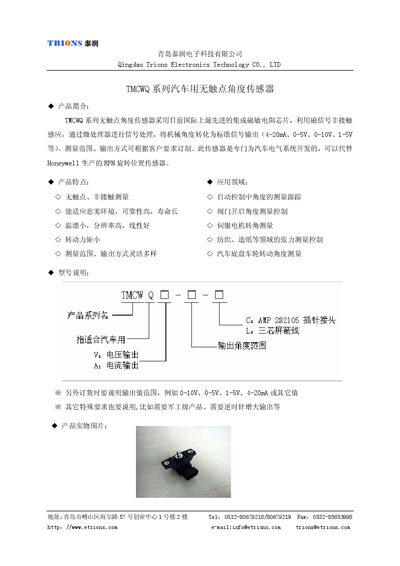
The TMCWQ series non‑contact angle sensor from Trions converts mechanical rotation into standard electrical signals (4‑20 mA, 0‑5 V, 0‑10 V, 1‑5 V, etc.) for automotive electrical systems. It offers high reliability, small temperature drift, high resolution and linearity, and can replace Honeywell RPN rotary position sensors.
The manual details product features, technical parameters, wiring options (plug or shielded cable), zero‑adjustment procedure, installation precautions, and typical output curves. Customizable measurement ranges and output formats are supported to meet specific customer requirements. This manual is written in Chinese.
| Working voltage | 10‑30 V DC |
|---|---|
| Mechanical rotation range | 360° |
| Angle measurement range | ±5° ~ ±180° (0° ~ 360° customizable) |
| Resolution | 12 bit (4096 steps) |
| Accuracy | ±0.03° ~ ±0.087° |
| Temperature drift | < 0.5° (‑20 °C ~ 80 °C) |
| Output signal options | 0‑5 V, 0‑10 V, 1‑5 V, 4‑20 mA or others |
| No‑load current | ≤ 16 mA |
| Load capacity | ≥ 2 kΩ (voltage output) / ≤ 500 Ω (current output) |
| Operating temperature | Industrial: ‑20 °C ~ 80 °C, Military: ‑40 °C ~ 125 °C |
| Protection rating | IP67 |
| Update period | 1 ms |
Pin 1 is ground, Pin 2 is the positive supply, and Pin 3 is the signal line.
Secure the sensor, connect it correctly, power it on, measure the output voltage or current to ground, and rotate the shaft until the output reads zero (e.g., 2.5 V for 0‑5 V output).
The sensor provides a 12‑bit resolution, equivalent to 4096 discrete steps.