
Honeywell SS100 series switch type Hall position sensor adopts square Hall sensor, which contains integrated square integrated circuit on square integrated circuit. The external package is made of glass filled heat-resistant molding material. The small SOT89 package can be installed on the flexible board of PCB. The balanced integrated circuit provides predictable performance in the whole temperature range of -40~+125˚C. The internal temperature compensation is a negative curve (the action/release point decreases with the increase of temperature). This characteristic is best matched with the negative temperature coefficient of low-cost magnet, with bipolar, single pole and latching type. Bandwidth gap adjustment provides very stable working performance in the power supply voltage range of 3.8~30VDC, and the power consumption can be as low as 10mA (maximum). SS100 can continuously output 20 mA sinking power and withstand short-term 50 mA current. The sensor can use the existing power supply in many applications and can be directly connected to many circuits without additional buffering and compensation circuits.
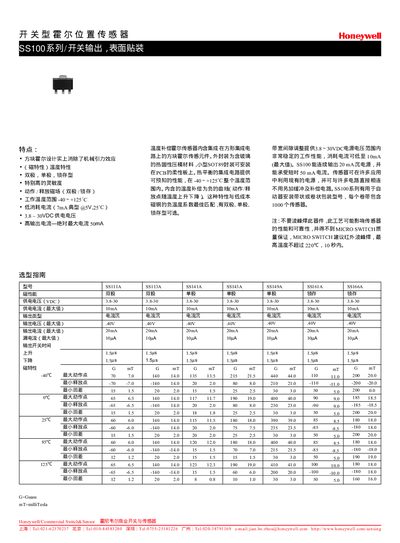
The Honeywell SS100 series is a surface‑mount switch‑type Hall position sensor offering bipolar, unipolar and latch options with built‑in temperature compensation. It operates over a wide temperature range and provides stable output across a 3.8 V to 30 VDC supply.
The device is supplied in a compact SOT‑89 package, suitable for PCB flex applications. Detailed electrical and magnetic characteristics are provided, along with selection guidance for various models such as SS111A, SS141A, and SS166A. This manual is written in Chinese.
| Operating temperature range | -40 °C to +125 °C |
|---|---|
| Supply voltage range | 3.8 VDC to 30 VDC |
| Typical current consumption | 7 mA @5 V, 25 °C |
| Maximum output current | 50 mA |
| Typical output current | 10 mA |
It operates from –40 °C up to +125 °C.
The sensor can be powered from 3.8 VDC to 30 VDC.
Typical current consumption is 7 mA at 5 V and 25 °C.
No, wave soldering may affect performance; infrared wave soldering is recommended with a maximum temperature of 220 °C for up to 10 seconds.