
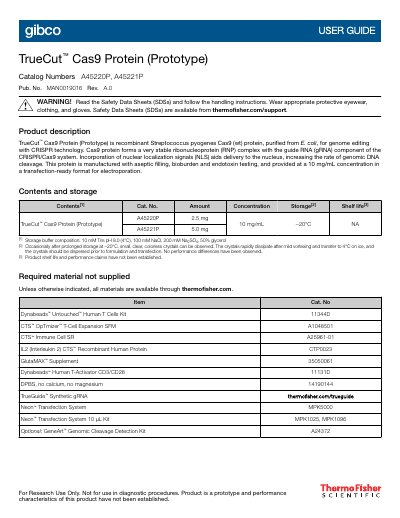
TrueCut™ Cas9 Protein (Prototype) is a recombinant Streptococcus pyogenes Cas9 (wt) protein, purified from E. coli, for genome editing with CRISPR technology. Cas9 protein forms a very stable ribonucleoprotein (RNP) complex with the guide RNA (gRNA) component of the CRISPR/Cas9 system. Incorporation of nuclear localization signals (NLS) aids delivery to the nucleus, increasing the rate of genomic DNA cleavage. This protein is manufactured with aseptic filling, bioburden and endotoxin testing, and provided at a 10 mg/mL concentration in a transfection-ready format for electroporation.
Thermo Fisher TrueCut™ Cas9 Protein (Prototype) is recombinant Streptococcus pyogenes Cas9 (wt) protein purified from E. coli for genome editing with CRISPR technology. The protein forms a stable ribonucleoprotein complex with guide RNA, and nuclear localization signals aid delivery to the nucleus.
The guide describes T-cell isolation and activation, preparation of the CRISPR-Cas9/gRNA complex, electroporation with the Neon™ Transfection System, and release specifications. The protein is supplied at 10 mg/mL in a transfection-ready format and is for research use only.
| Catalog number A45220P amount | 2.5 mg |
|---|---|
| Concentration | 10 mg/mL |
| Storage temperature | −20°C |
| Storage buffer composition | 10 mM Tris pH 8.0 (4°C), 100 mM NaCl, 200 mM Na2SO4, 50% glycerol |
| Activity assay | ≥90.0% in vitro of uncut reference DNA converted to cleavage products |
| Endotoxin | <10.0 EU/mg |
| Bioburden | <1 CFU/mL |
| Purity by HPLC-DAD | ≥95.0% |
| Purity by SDS-PAGE | ≥95.0% |
| Aggregation by SEC-HPLC | ≤5.0% |
| Residual host protein | <10.0 ng/mL protein |
| Residual DNase | |
| Residual RNase | |
| Residual host genomic DNA | |
| Residual plasmid DNA | |
| Mycoplasma |
It is recombinant Streptococcus pyogenes Cas9 (wt) protein, purified from E. coli, for genome editing with CRISPR technology.
It is provided at a 10 mg/mL concentration.
Use program #24 (1600 V/10 ms/3 pulses); programs #5, #16 and #23 also work well for T-cells.
No. It is for research use only and is not for use in diagnostic procedures.