
The AD7000W is a versatile sound system that can connect to your home Wi-Fi network and stream music from your iTunes library via AirPlay. It also has a USB port that lets you connect your iPod/iPhone/iPad and control it with the remote control.
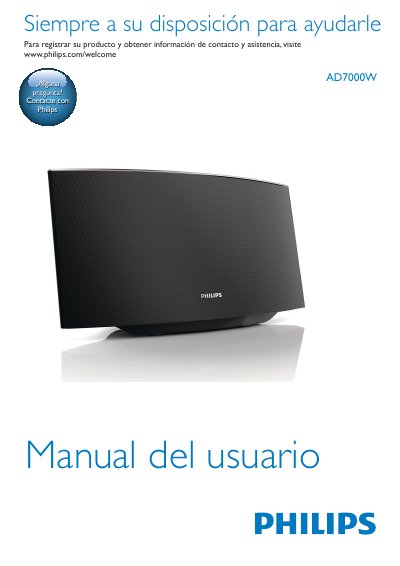
The Philips AD7000W is an entertainment system with a built-in Wi-Fi module. The manual explains AirPlay setup and streaming from an iTunes music library on a Mac, PC, iPhone, iPod touch, or iPad over a home Wi-Fi network.
It also covers power connection and turning on the unit, playback controls and sound settings, charging or playing an iPod/iPhone/iPad through the USB socket, playback from an external device through MP3-LINK, firmware updates, product information, and troubleshooting. This manual is written in Spanish.
| Wireless module | Built-in Wi-Fi |
|---|---|
| USB port | Charges iPod/iPhone/iPad through the USB socket |
| MP3-LINK input | Connects an external audio player using the supplied MP3 connection cable |
| Power input | DC IN for the AC power adapter |
You can connect an iPod, iPhone, or iPad using an Apple USB cable, which is not included.
Initialization can take about 35 seconds.
Connect the external audio player to the MP3-LINK socket using the supplied MP3 connection cable.