
This document is a user manual for the ESPAÑOL V3100 Class B Transponder AIS.
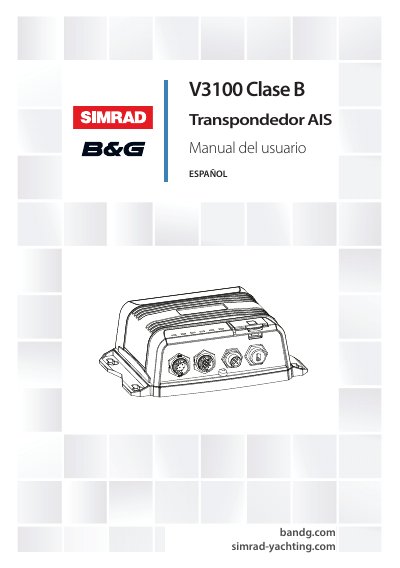
This is the Spanish-language user manual for the Simrad V3100, a SOTDMA Class B AIS transponder published by Navico Holding AS. The manual explains how the AIS system works, describes the product, and covers installation procedures, transponder configuration, entering vessel data, getting started, LED indicators, built-in integrity testing (BIIT) and data logging to a micro SD card.
The V3100 is described as a globally approved SOTDMA Class B AIS with 5 W transmission power, one VHF transmitter, two AIS receivers on two VHF channels, and an internal 50-channel GNSS receiver that can process GPS, Galileo, BeiDou and GLONASS signals. It integrates with a chartplotter or PC via waterproof NMEA 2000, NMEA 0183 and USB ports, and has an IPx7 water-resistant enclosure. The manual also includes product specifications, dimensions, supported NMEA 2000 PGNs and NMEA 0183 sentences, troubleshooting and abbreviations. This manual is written in Spanish.
| AIS class | SOTDMA Class B |
|---|---|
| Transmission power | 5 W |
| Transmitters/receivers | 1 VHF transmitter, 2 AIS receivers on 2 VHF channels |
| GNSS receiver | Internal, 50 channels, GPS/Galileo/BeiDou/GLONASS |
| Water resistance | IPx7 |
| Antenna impedance | 50 ohms |
| MPE exposure radius | 1.2 m |
| Data ports | NMEA 2000, NMEA 0183 and USB |
The required antenna impedance is 50 ohms.
The antenna should be mounted 3.5 m above the deck to meet RF exposure requirements, and at least 1.5 m from the AIS transponder.
Yes, it has a built-in data logger that can record AIS data to a micro SD card.
The 50-channel internal GNSS receiver can process GPS, Galileo, BeiDou and GLONASS signals.