
Guidelines for the Implementation of a Farmer Field School (FFS) in St. Lucia.
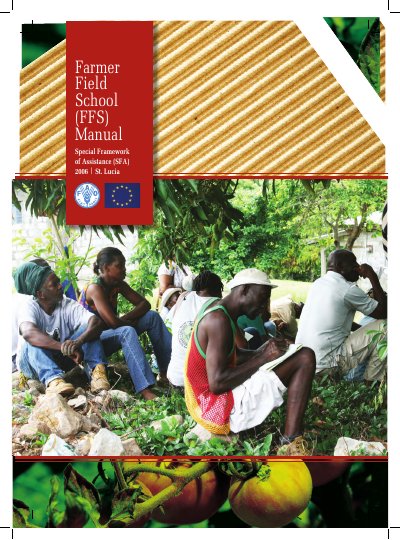
This manual was compiled for the Ministry of Agriculture, St. Lucia with assistance from FAO and financing from the European Union's Special Framework of Assistance (SFA 2006). It introduces the Farmer Field School approach, its concept, principles, and methods for IPM in watermelons, and notes it can guide FFS in other crops.
It covers implementation steps from selecting farmers and venues to materials, preparation, conducting sessions, post-evaluation, and stakeholders' field days. It also includes discovery learning on insect collection and identification, group dynamic activities, ice breakers and energisers, appendices, and a bibliography.
| FFS group size | 10-30 farmers |
|---|---|
| TOT/FFS training period | June – November 2009 |
It is a group-based learning process based on learning by doing that empowers farming communities through experiential learning.
An FFS consists of 10-30 farmers.
Each meeting includes at least an agro-ecosystem analysis, a special topic, and a group dynamics activity.