
Key facts
- Manuals
- 3
- Languages
- ES · ZH · EN
- Last added
- 2026-10-18
Featured FAO manuals
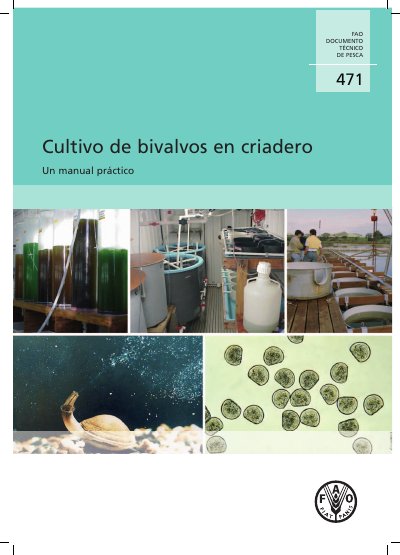
FAO 471 Bivalve Hatchery Cultivation Practical Manual
This manual provides a practical overview of the intensive cultivation of bivalves in hatcheries. It synthesizes current methodologies applicable to the production of oysters, clams, and scallops, covering various climatic regions. The text details the entire cultivation process, including site selection, facility design, and the management of seed production before transfer to grow-out areas. This manual is written in Spanish.
Covers: Selection of the site · Design of the hatchery · Economic aspects · Basic biology of bivalves · Cultivation of algae · Conditioning of broodstock
FAO Soil Testing Methods Manual: Soil Doctors Global Programme
The "Soil Testing Methods Manual" is part of the FAO Chinese Publication Project series. It aims to provide a range of methods for evaluating key parameters of soil health for soil researchers and farmers. The manual covers assessment methods for physical, chemical, and biological characteristics of soil.
It includes a section on Visual Soil Assessment (VSA) to provide information on soil health. The manual is part of the Soil Testing Kit (STK) developed by the Global Soil Research Project. It offers various testing methods applicable to different climates, crops, and soil types. This manual is written in Chinese.
Covers: Introduction · Soil Physical Properties · Soil Texture · Bulk Density · Soil Moisture · Soil Chemical Properties
FAO ETo Calculator Reference Manual
The document is a user guide for the ETo Calculator, Version 3.1, developed by the Food and Agriculture Organization of the United Nations (FAO). It details how to calculate reference evapotranspiration (ETo) from a reference surface using climatic parameters such as radiation, temperature, humidity, and wind speed.
The manual covers the software's menu structure, database management for creating and selecting station files, importing data from various text formats (including FAO Clim 2.0 and CLIMWAT 2.0), and performing ETo calculations based on the FAO Penman-Monteith method.
Covers: Reference evapotranspiration · Menu Reference · Data base management · Importing climatic data · Atmospheric parameters · Air temperature
Latest FAO manuals
FAO 471 Bivalve Hatchery Cultivation Practical Manual
User Manual 198 pages · 11.1 MB · ESA practical guide by the FAO covering the intensive cultivation of bivalves in hatcheries, from site selection and design to broodstock conditioning and…
FAO Soil Testing Methods Manual: Soil Doctors Global Programme
User Manual 82 pages · 4.9 MB · ZHThis manual provides methods for evaluating soil health parameters, including physical, chemical, and biological indicators, suitable for researchers and…
FAO ETo Calculator Reference Manual
User Manual 38 pages · 1.2 MB · ENThis manual describes the FAO ETo Calculator software for computing reference evapotranspiration using the Penman-Monteith method.
Which document do I need?
User Manual
Day-to-day operation, settings and troubleshooting. Start here if the product is already set up.
Questions answered in FAO manuals
What is the primary purpose of this manual?
This document serves as a practical guide for the intensive cultivation of bivalves in hatcheries.
Which specific species are covered in this manual?
The text includes examples for the Japanese oyster, virginian oyster, European oyster, Japanese clam, and various scallop species.
What is the primary purpose of this manual?
The manual provides a series of methods for evaluating key parameters of soil health to offer preliminary data for researchers and farmers.
From: FAO Soil Testing Methods Manual: Soil Doctors Global Programme
How does the Soil Testing Methods Manual assist with decision making?
It allows users to make timely field management decisions based on test results obtained from the soil.
From: FAO Soil Testing Methods Manual: Soil Doctors Global Programme
What is the standard method for calculating reference evapotranspiration?
The FAO Penman-Monteith method is recommended as the standard method.
What file extensions are used for station and meteorological data files?
Station characteristics use .DSC files, while meteorological data uses .DTA files.