
This document describes how to use an electric conveyor toaster
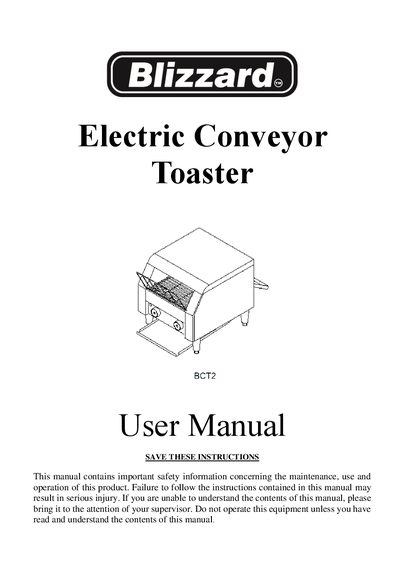
This Electric Conveyor Toaster User Manual explains how to install, set up, operate and clean a conveyor toaster. It is designed to speed the toasting operation: bread products pass through a heating chamber, and the manual notes that dryness, moisture, sugar content and thickness of the bread affect the result, while conveyor speed rather than temperature determines the toasting colour.
The manual opens with owner and warranty information and detailed safety notices, then covers unpacking and location requirements, set-up of the toast feed ramp and crumb tray, front or rear discharge configuration, and operation for models with a rocker switch or a rotary selector. It closes with power save mode and maintenance, including instructions for cleaning the exterior, crumb tray, collector pan and feed ramp.
| Minimum ambient operating temperature | 70 °F (21 °C) |
|---|---|
| Maximum ambient operating temperature | 85 °F (29 °C) |
| Side clearance | minimum 1 in (3 cm) |
| Front and rear discharge clearance | 12 in (31 cm) |
| Ceiling clearance | not closer than 12 in (31 cm) |
| Warm-up period (rocker switch model) | approximately 15 to 21 minutes |
| Warm-up period (rotary selector model) | approximately 15 to 20 minutes |
| Power Save Mode output | 25% power |
| Time to return to full power | within 5 minutes |
| Leg adjustment wrench size | 9/16 in open-end wrench |
For models with a rocker switch, allow approximately 15 to 21 minutes for the warm-up period. For models with a rotary selector, the manual states approximately 15 to 20 minutes.
Conveyor speed, not temperature, determines the toasting colour. Slowing the conveyor with a darker setting is recommended for moist products such as English muffins, rye bread or whole wheat.
The toaster can be configured to discharge in the front or rear: pull up the rear discharge door for front discharge and push down the rear discharge door for rear discharge.
It is recommended that the exterior surfaces be wiped daily with a damp cloth, and stubborn stains removed with a good stainless-steel cleaner or non-abrasive cleaner. Abrasive cleaners could scratch the finish.