
An application note about the crystal selection guide for Dallas Single Chip Transceivers
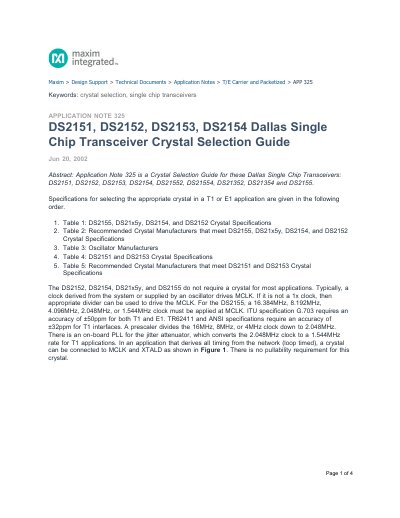
Application Note 325 from Maxim provides crystal selection guidance for Dallas single-chip transceivers, including the DS2151, DS2152, DS2153, DS2154, DS21552, DS21554, DS21352, DS21354, and DS2155. It presents crystal specifications in tables for the DS2155, DS21x5y, DS2154, and DS2152, and separately for the DS2151 and DS2153, along with recommended crystal and oscillator manufacturers.
The note states that the DS2152, DS2154, DS21x5y, and DS2155 do not require a crystal for most applications; MCLK is typically driven by a system clock or supplied by an oscillator. For loop-timed applications, a crystal can be connected to MCLK and XTALD as shown in Figure 1, and no pullability is required. The DS2151 and DS2153 require a crystal that can be pulled off its center frequency.
| Parallel resonant frequency, DS2155/DS21x5y/DS2154/DS2152 | 1.544 MHz (T1), 2.048 MHz (E1) |
|---|---|
| Crystal mode, DS2155/DS21x5y/DS2154/DS2152 | Fundamental |
| Crystal cut, DS2155/DS21x5y/DS2154/DS2152 | AT |
| Tolerance, DS2155/DS21x5y/DS2154/DS2152 | ±50 ppm |
| Parallel resonant frequency, DS2151/DS2153 | 6.176 MHz (T1), 8.192 MHz (E1) |
| Load capacitance, DS2151/DS2153 | 18 pF to 20 pF |
| Pullability at CL = 10 pF, DS2151/DS2153 | +175 to +250 ppm |
| Pullability at CL = 45 pF, DS2151/DS2153 | +175 to -250 ppm |
| Effective series resistance, DS2151/DS2153 | 35 Ω max |
| Crystal cut, DS2151/DS2153 | AT |
Table 4 specifies 6.176 MHz for T1 and 8.192 MHz for E1.
No. The note says they do not require a crystal for most applications; MCLK is typically driven by a system clock or supplied by an oscillator.
ITU G.703 requires an accuracy of ±50 ppm for both T1 and E1.