
This Maxim guide explains how to choose CMOS analog switches and shows typical applications for many Maxim part numbers.
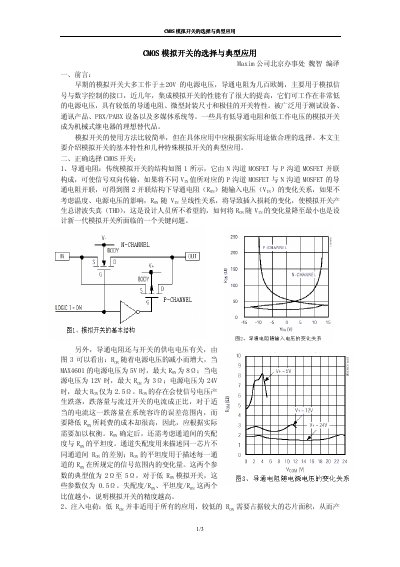
The document introduces the evolution of CMOS analog switches, highlighting their lower on‑resistance, reduced supply voltage, and compact SOT‑23 packaging. It discusses key selection criteria such as on‑resistance, charge injection, and power‑supply configuration, and explains how these parameters affect signal integrity and system performance.
Several special‑purpose switch families are described, including high‑frequency T‑type switches, miniature package devices, ESD‑protected switches, fault‑protected switches, load‑sense switches, and calibration multiplexers. For each family the guide lists representative Maxim part numbers, typical electrical characteristics, and example applications such as video routing, automated test equipment, and high‑precision measurement systems. This manual is written in Chinese.
| MAX4601 On‑Resistance at 5 V | 8 Ω |
|---|---|
| MAX4601 On‑Resistance at 12 V | 3 Ω |
| MAX4601 On‑Resistance at 24 V | 2.5 Ω |
| Load‑Sense Switch (MAX4556) Load‑Current Path R_ON | 6 Ω |
| Load‑Sense Switch (MAX4556) Sense Path R_ON | 60 Ω |
| MAX4545 T‑Type Switch Isolation at 10 MHz | -80 dB |
At 5 V the maximum R_ON is 8 Ω, at 12 V it is 3 Ω, and at 24 V it is 2.5 Ω.
The MAX4545 T‑type switch offers -80 dB isolation at 10 MHz, far better than the -36 dB of the standard MAX312.
Maxim’s ESD‑protected switches can withstand ±15 kV static discharge and meet IEC1000‑4‑2 Level 4 requirements.
The load‑current path has an on‑resistance of about 6 Ω, while the sense path is about 60 Ω.