
The Ideal Diode Circuit Analysis Guide

How to analyze ideal diode circuits
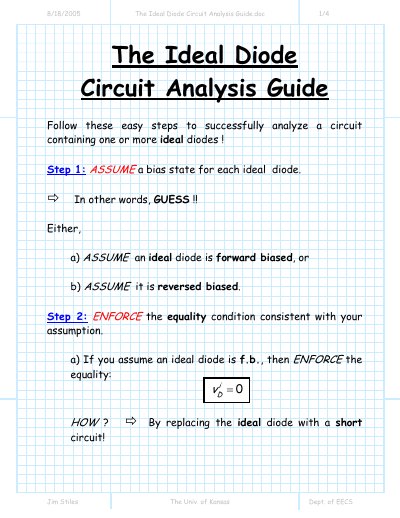

The Ideal Diode Circuit Analysis Guide - cover page
Document type
Other
Language
English
Pages
4
File format
PDF
File size
76 KB
Published
31 October, 2023
Updated
31 October, 2023
MD5 checksum
FDA8D03D4ABEEFA6B07E1904FB480DEB

About this manual

This four-page guide outlines a five-step method for analyzing circuits with one or more ideal diodes. It describes assuming a forward- or reverse-biased state for each ideal diode, replacing the diode with a short or open circuit, solving the circuit, and checking the assumption.

The guide explains that an ideal diode cannot have negative current or positive voltage, and notes that one and only one assumption will be valid for every circuit. It also advises checking all assumptions and not checking the condition that was enforced.

What's inside

  • Step 1: bias state for each ideal diode
  • Step 2: equality condition consistent with assumption
  • Step 3: solve the circuit
  • Step 4: check the inequality
  • Step 5: revise incorrect assumptions
  • Notes on ideal diode circuit analysis

Frequently asked questions

What does the guide say to do in Step 1?

It says to assume a bias state for each ideal diode, either forward biased or reverse biased.

How do you enforce a forward-biased assumption?

Replace the ideal diode with a short circuit.

How can you tell if a reverse-biased assumption is correct?

Check that the open circuit voltage is negative.

What does the guide say about valid assumptions for a circuit?

For every circuit, one and only one assumption will be valid.

Download PDF (76 KB)

Also Manuals