
ME3-ETO electrochemical gas sensor is based on the principle of electrochemistry and has the characteristics of low power consumption, high accuracy, high sensitivity, wide linear range, strong anti-interference ability, excellent repeatability and stability. It is widely used in the detection of ETO in industry and environmental protection.
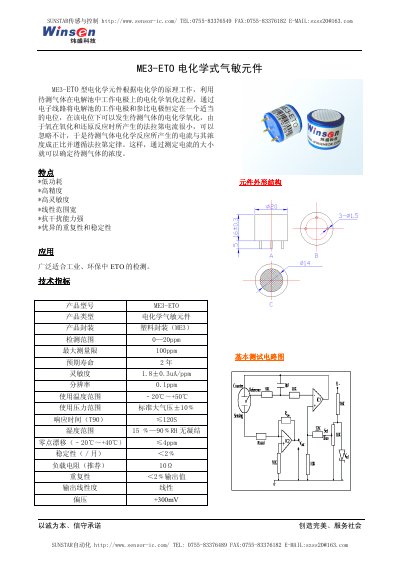
This is the Chinese product manual (version 1.0) for the Winsen ME3-ETO electrochemical gas sensor element, a plastic-packaged (ME3) sensing component for detecting ETO. It explains the electrochemical principle of operation, lists the element's features such as low power consumption, high sensitivity and a wide linear range, and names industrial and environmental ETO detection as its applications.
The document gives the full technical specifications, a basic test circuit, sensitivity and zero-point temperature characteristic curves, a table of typical responses to interfering gases, and a list of precautions covering solvents, corrosive atmospheres, handling of the pins, the gas inlet, aging before use and storage with the electrodes shorted. Contact details and the company address in Zhengzhou are printed at the end. This manual is written in Chinese.
| Product type | Electrochemical gas sensor element |
|---|---|
| Package | Plastic package (ME3) |
| Detection range | 0–20 ppm |
| Maximum measurement limit | 100 ppm |
| Expected lifetime | 2 years |
| Sensitivity | 1.8 ± 0.3 uA/ppm |
| Resolution | 0.1 ppm |
| Operating pressure range | Standard atmospheric pressure ±10% |
| Response time (T90) | ≤120 s |
| Humidity range | 15%–90% RH, non-condensing |
| Zero drift (-20 °C to +40 °C) | ≤4 ppm |
| Recommended load resistor | 10 Ω |
| Repeatability | <2% of output value |
| Bias voltage | +300 mV |
The detection range is 0–20 ppm, with a maximum measurement limit of 100 ppm.
A bias voltage of +300 mV is specified.
The sensor must be aged for no less than 24 hours before use, and soldering must not be used during installation.
The manual lists responses to ethanol (<55%), toluene (<10%), methyl ethyl ketone (<20%) and carbon monoxide (<40%).