
DM432C is a new digital stepping motor driver launched by Leisai Company. It adopts the latest 32-bit DSP technology. Users can set any subdivision within 256 and any current value within the rated current. It can meet the application needs of most occasions. Since it adopts the built-in micro-division technology, even in the case of low subdivision, it can achieve the effect of high subdivision, low-medium-high speed operation are very stable and noiseless. The internal driver has a parameter auto-tuning function that can automatically generate the best operating parameters for different motors to maximize the performance of the motor.
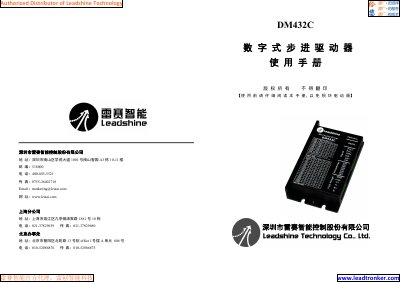
The Leadshine DM432C is a digital stepper motor driver built with 32-bit DSP technology. It allows users to set microstep and current values within the rated range, includes built-in microstepping and automatic parameter tuning, and is intended for small and medium automation equipment such as engraving machines, marking machines, cutting machines, laser phototypesetting equipment, plotters, CNC machine tools, and automatic assembly equipment.
The manual covers electrical, mechanical, and environmental specifications; driver interfaces and wiring; current and microstep DIP switch settings and parameter auto-tuning; power supply selection; motor selection; typical wiring examples; protection functions; and common questions. It also includes the Leadshine product warranty terms. This manual is written in Chinese.
| Output current | 1.0 to 3.2 A |
|---|---|
| Input power supply voltage | 20 VDC min, 24 VDC typical, 40 VDC max |
| Control signal input current | 7 mA min, 10 mA typical, 16 mA max |
| Step pulse frequency | 0 to 75 kHz |
| Insulation resistance | 50 MΩ |
| Humidity | 40 to 90% RH |
| Vibration | 5.9 m/s² max |
| Storage temperature | -20 to 80 °C |
| Weight | 190 g |
| Microstep range | 1 to 512 |
| Compatible motors | 4-, 6-, 8-wire two-phase stepper motors |
It accepts 20 to 40 VDC; a value around 24 VDC is recommended.
Use automatic half-current mode so current is halved when the motor stops.
One flash indicates an overcurrent or phase-to-phase short-circuit fault.
The highest pulse response frequency is 75 kHz.