
The 2450 pressure sensor is a sensor that is compatible with corrosive liquids, with a PVDF one-piece injection molded body and ceramic diaphragm
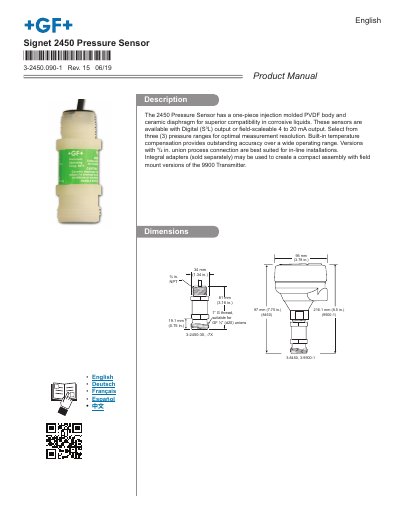
This manual provides installation and wiring instructions for the Signet 2450 Pressure Sensor, including union and in-line mounting options. It details electrical specifications, safety precautions, and compatibility with GF transmitters. The sensor features a PVDF body and ceramic diaphragm for corrosion resistance and is available with digital or 4-20mA outputs.
Safety and installation guidelines emphasize depressurizing systems, avoiding overpressure, and using proper PPE. The manual also covers environmental limits, proof pressure ratings, and wiring configurations for both digital and analog outputs.
| Sensor Accuracy | ±1% of full scale @ 25 °C |
|---|---|
| Thermal Sensitivity Shift | 0.03% of full scale per °C |
| Max Loop Impedance (4-20mA) | 1000Ω @12V, 3250Ω @18V, 600Ω @24V |
| Power Requirements (Digital) | 5 to 6.5 VDC +10%, <1.5 mA |
| Power Requirements (4-20mA) | 12 to 24 VDC +10% regulated |
| Cable Length | 4.6 m (15 ft) |
| Wetted Materials | Sensor housing: PVDF; Diaphragm: Ceramic; Seal: FKM |
| Process Connection | 1/2 in. Union male thread or 3/4 in. NPT male thread |
The sensor offers three pressure ranges: -0.1 to 0.7 bar (–1.5 to 10 psi) for -XU, -0.4 to 3.4 bar (–6 to 50 psi) for -XL, and -0.96 to 17.2 bar (–14.6 to 250 psi) for -XH.
The proof pressure is 150 bar (2175 psi) for -XU, 5.2 bar (75 psig) for -XL, and 20.7 bar (300 psig) for -XH.
The resolution is 0.01 psi (0.001 psi for -XU).
Depressurize and vent the system, drain below sensor level, wear safety goggles, and do not alter product construction. Do not exceed maximum temperature/pressure specifications.