
This is a valve operation guide that introduces the basic operation principle and application scenarios of basic valves.
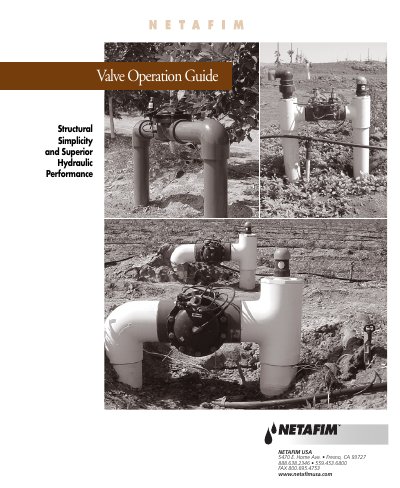
This guide explains how to operate Netafim’s basic and automatic control valves, covering hydraulic principles, valve sizing, installation, and troubleshooting. It includes detailed sections on diaphragm operation, pressure ratings, flow velocities, and media compatibility. The guide also provides electrical schematics for solenoid valves and troubleshooting steps for common operational issues.
Valves are designed for use with slurries, sewage, and abrasive media due to their shaftless, bearing-free design. The guide includes a sizing chart based on flow rate and line pressure, and explains how to select appropriate diaphragms for different applications.
| Operating Pressures | Medium: up to 230 Psi; High: up to 350 Psi; Plastic: up to 150 psi |
|---|---|
| Maximum Flow Velocity | 23-24 feet/sec without noise or cavitation |
| Cavitation Resistance | Resistant to cavitation up to 3:1 pressure ratio; bronze or orifice plate required for 5:1 ratios |
| Diaphragm Material | Reinforced rubber diaphragm |
The valves are suitable for controlling slurries, untreated sewage, water with high sand content, and normal water media due to their shaftless, bearing-free design.
Plastic valves are rated for up to 150 psi.
Use the provided sizing chart: locate flow rate on the horizontal axis and line pressure on the vertical axis; the intersection indicates the valve size and diaphragm type (standard, charcoal, or black for special low-pressure diaphragms).
Do not exceed a 3:1 ratio of upstream to downstream pressure; use bronze or orifice plate for 5:1 ratios.