
This document describes a device for separating sand from water. The device is called a Hydrocyclone. The Hydrocyclone uses centrifugal force to separate sand and other solid matter from water. The efficiency is high, and the device does not clog when in use. The Hydrocyclone is easy to operate and maintain, and has no moving parts or screens.
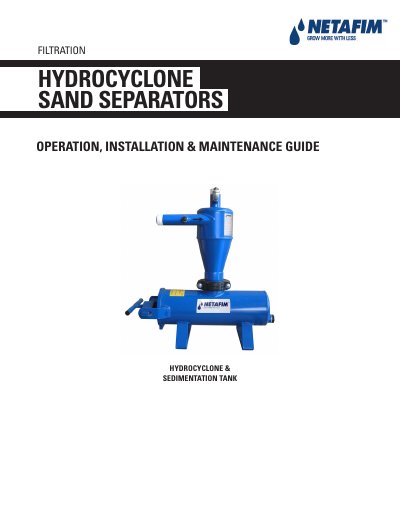
This guide explains how to operate, install, and maintain Netafim hydrocyclone sand separators. It covers installation guidelines, automatic flushing options, sedimentation tank flushing, and maintenance procedures including rubber insert replacement and coating repair. Specifications include model sizes, flow rates, headloss, and dimensions for various configurations.
The separators use centrifugal force to separate sand and solids from water with high efficiency and minimal head loss. They feature a protective polyester coating and rubber inserts to prevent erosion. Automatic flushing kits are available for automated sediment removal. Maintenance includes annual greasing and timely replacement of worn parts.
| Recommended Headloss | 3-7 psi |
|---|---|
| Maximum Working Pressure | 120 psi |
| Maximum Pressure | 150 psi |
| Available Sizes | 3”, 4”, 6”, 8”, 12”, 16”, 20”, 24”, 30” |
| End Connections | Thread (TH), Flange (FL), Groove (GR) |
| Sedimentation Tank Capacities | 0.4 to 60 gallons |
The recommended headloss for effective operation is 3-7 psi.
The maximum recommended working pressure is 120 psi.
The rubber insert should be replaced every 2-3 years when separating sand, or every year when separating silt.
The automatic flushing kit includes an electric valve, controller, and small command filter to drain the Sedimentation Tank automatically without interfering with Hydrocyclone operation.