
This document is the product manual of the ILM-4 sensor, which mainly introduces the functions and features of the sensor, installation methods, operating methods, maintenance methods, etc.
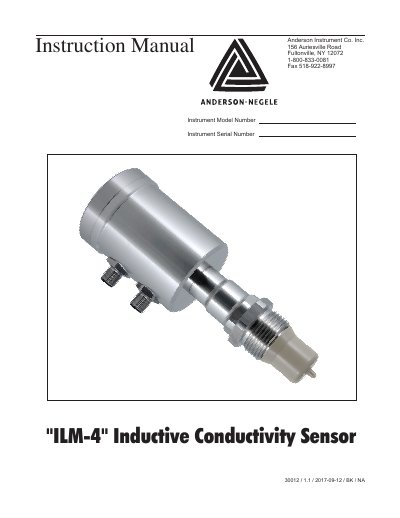
The Anderson Instrument ILM-4 is an inductive conductivity sensor designed for measuring liquid conductivity in dairy, food, and beverage applications. It features a 316L stainless steel and PEEK construction, is 3-A authorized, and offers programmable ranges from 0.5 to 999 mS/cm. The sensor provides backlit LCD display and analog outputs (4-20 mA) with optional digital input for range selection.
| Process Connection | G1", 1.5", 2", 2.5", 3" |
|---|---|
| Materials Connection Head | 1.4305 (303 Stainless) |
| Fitting Material | 1.4404 (316L) |
| Toroid Material | PEEK |
| Window Material | PMMA/Acrylic |
| Ambient Temperature Range | -10-70 °C (14-158°F) |
| Process Temperature Range | 0-130 °C (32-266°F) |
| CIP/SIP-Cleaning Temperature | up to 150°C (300°F) for up to 60 minutes |
| Operating Pressure | 10bar (150 psi) maximum |
| Measurement Principle | Inductive conductivity |
| Measurement Ranges | 0.5 to 999mS/cm, Freely programmable |
| Repeatability | within < 1% of measured value |
| Response Time (temperature) | T90 15…60sec |
| Display | backlit LCD, 5 lines |
| Supply Voltage | 24 (18-35 VDC)@ 190 mA |
| Environmental Protection | IP69K |
The ILM-4 is designed for measuring liquid electrical conductivity in the food processing, beverage, pharmaceutical, and chemical industries.
All wetted parts are constructed of 316L stainless steel and PEEK plastic.
The maximum operating pressure is 10 bar (150 psi).
Yes, it can withstand CIP/SIP cleaning up to 150°C (300°F) for up to 60 minutes.