
This is the instruction manual of Anderson Instrument Co. Inc.'s D3 differential pressure and level transmitter, which mainly introduces the product specifications, warnings, dimensional drawings, working principles and descriptions, installation, sensor wiring, instrument wiring, modular assembly, configuration, HART communicator connection and DD menu structure, maintenance/diagnostics, etc.
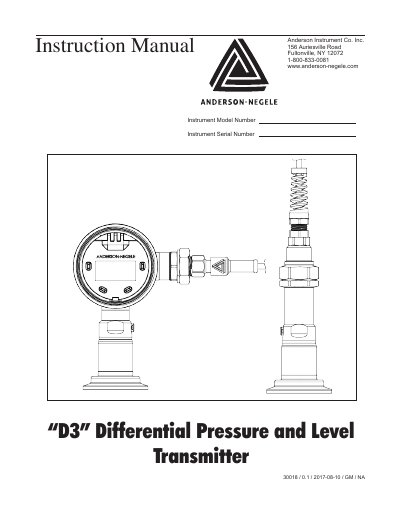
The Anderson Instrument D3 Differential Pressure and Level Transmitter is designed for liquid measurement applications in the food and beverage industry. It utilizes an internal piezoelectric transducer and an RTD temperature element to measure pressure and temperature, converting these signals into industry-standard 4...20mA and Hart 7.0 outputs. The unit features an integral display and a four-button interface for reconfiguration of parameters such as tank geometry and product density.
| Measuring range | -14.7...500 psi |
|---|---|
| Measurement accuracy | 0.05 % |
| Temperature range (Process) | -18...110 °C |
| Auxiliary Power Supply Voltage | 18...35 V DC |
| Output Loop | analog 4...20 mA and Hart 7.0 |
| Tightening torque | 27 Nm (20 ft-lbs) |
Anderson - Negele recommends a cable of 24 gauge, 4 conductor, shielded.
No, this unit accepts DC voltage only, and connection to AC voltage can cause failure of the sensor and/or risk of electrocution.
The tightening torque for assembly of all D3 components is 27 Nm (20 ft-lbs).