
This document introduces the features and usage methods of Fisher L2 liquid level controller, including installation, changing controller action or mode, adjusting range, etc.
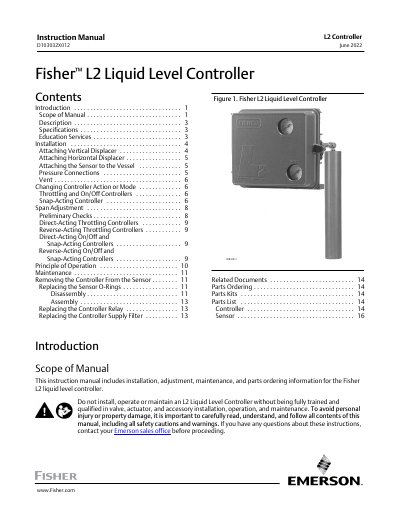
The Fisher L2 Liquid Level Controller is a rugged device that uses a displacer-type sensor to detect liquid level or the interface of two liquids with different specific gravities. It utilizes a single four-mode relay to provide applicable control and action, delivering a pneumatic output signal to a control or dump valve. The manual is intended for users fully trained and qualified in valve, actuator, and accessory installation, operation, and maintenance.
| Control Mode | Throttling, On/Off, Snap-acting |
|---|---|
| Input Signal Type | Liquid level or liquid-to-liquid interface |
| Output Signal | Pneumatic /C0074on-off or /C0074proportional pressure signal |
| Supply Pressure Requirements (Throttling) | 1.4 bar for 0.2 to 1.0 bar output signal |
| Supply Medium | Air or natural gas |
| Steady-State Air Consumption (Throttling) | ≤0.03 normal m3/hr (1.0 scfh) at 1.4 bar (20 psig) |
| Sensor to Vessel Connection | 2 NPT threaded or NPS 2 CL150 through 1500 slip-on flange |
| Controller Case Vent | 1/4 NPT internal with vent screen assembly |
| PVC Displacer Temperature Limits | -18 to 71°C (0 to 160°F) |
| S31603 SST Displacer Temperature Limits | -40 to 204°C (-40 to 400°F) |
The minimum specific gravity for Throttling Controllers is 0.4.
Yes, the action is field-reversible between direct and reverse.
A Throttling Controller requires 1.4 bar for a 0.2 to 1.0 bar output signal.
The maximum working pressure for a PVC Displacer is 258 bar (3750 psig).