
This document is the Edimax AC-M3000/AC-M1000 Network Access Controller User's Manual, which introduces the product's hardware specifications, system concept, installation steps, software configuration, etc.
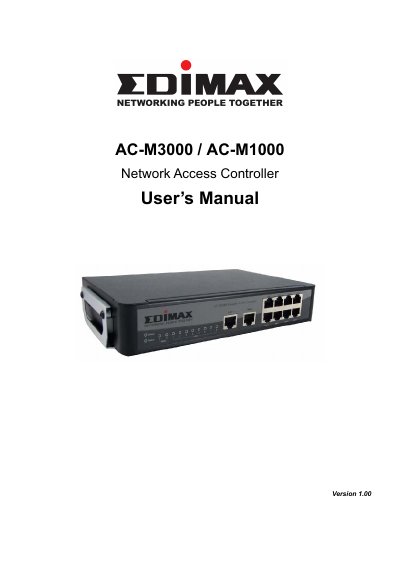
This manual provides step-by-step instructions for setting up and configuring the Edimax AC-M3000 and AC-M1000 Network Access Controllers. It covers hardware installation, software configuration, web interface settings, user authentication, AP management, and system administration. The device supports user authentication, access control, and security management for small-scale wireless and wired networks.
The AC-M3000 supports up to 120 concurrent users and 500 local accounts, while the AC-M1000 supports 50 concurrent users and 250 local accounts. Both models support up to 2,000 on-demand accounts and can manage up to 12 or 4 IEEE 802.11b/g APs respectively. Features include DHCP, NAT, VPN pass-through, and role-based access control.
| Dimensions | 243 mm x 150 mm x 45.5 mm |
|---|---|
| Weight | 1.4 Kg |
| Operating Temperature | 0 ~ 45 ℃ |
| Storage Temperature | 0 ~ 65 ℃ |
| Power | 110~220 VAC, 50/60 Hz |
| Ethernet Interfaces | 10 x Fast Ethernet (10/100 Mbps) |
| WAN Ports | 2 x 10BASE-T/100BASE-TX RJ-45 |
| LAN Ports | 8 x 10BASE-T/100BASE-TX RJ-45 |
| Concurrent Users (AC-M3000) | 120 |
| Local Accounts (AC-M3000) | 500 |
| On-demand Accounts | 2,000 |
| Managed APs (AC-M3000) | 12 |
| VPN Tunnels (AC-M3000) | 120 |
| VPN Throughput (AC-M3000) | 30 Mbps |
The device supports user authentication, access control, AP management, and security management for small-scale wireless and wired networks. It includes features like DHCP, NAT, VPN pass-through, and role-based access control.
The AC-M3000 supports up to 120 concurrent users.
The AC-M3000 supports 120 concurrent users and 500 local accounts, while the AC-M1000 supports 50 concurrent users and 250 local accounts. The AC-M3000 also supports 12 managed APs, while the AC-M1000 supports 4.
The device supports data encryption (WEP, WPA, WPA2), authentication (WPA-PSK, WPA2-PSK, IEEE 802.1x), and VPN pass-through (IPSec and PPTP).