
The DC385 is a high density synchronous step-down (buck) regulator using the LTC®1778 No RSENSE™ switching regulator controller. This controller uses a valley current control architecture to deliver very low duty cycles without requiring a sense resistor. It provides high efficiency operation at light loads by means of discontinuous mode operation. Noise and RF interference are reduced by means of a forced continuous control pin. The circuit uses a dual SyncFET™ and has a very small footprint. With a wide operating range of VIN from 5V to 28V and a duty cycle of 2% to 90% at 200kHz, the circuit demonstrates that the LTC1778 is ideal for applications such as notebook and palmtop computers, PDAs, battery chargers and distributed power systems.
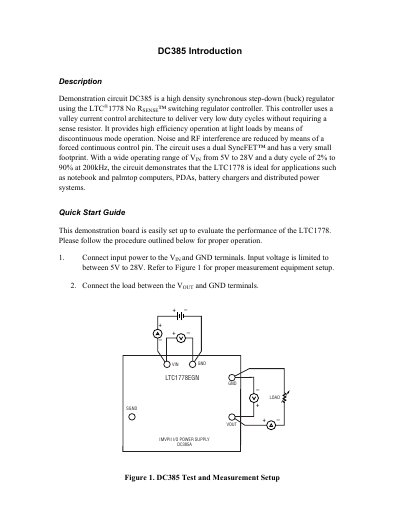
This guide explains how to set up and operate the DC385 demonstration circuit, which uses the LTC1778 synchronous step-down regulator. It covers connecting input power, attaching a load, configuring operation modes via FCB and RUN/SS pins, and measuring ripple. The circuit is designed for applications like notebook computers and battery chargers.
Input voltage is limited to between 5V to 28V.
The duty cycle is 2% to 90% at 200kHz.
To shut down the circuit, connect the RUN/SS signal to the SGND terminal.